
From Religion to Reason: Voltaire, Diderot, d’Holbach and the Public Perception of Christianity in Revolutionary France
On December 25, 800 C.E., Charlemagne was crowned Emperor of the Holy Roman Empire by Pope Leo III. Charlemagne’s coronation solidified the authority of the papacy and the Catholic Church over the future nations of Europe for centuries to come. As the years progressed, the Catholic faith became the force that legitimized the rule of kings and queens across Western Europe and drove the power of the Catholic Church in French society. By the turn of the 18th century, the dawn of a new era emerged in France. It was an era associated with both the diffusion of Enlightenment ideals and the intense fervor of the French Revolution. As a result of the French Enlightenment, the ideas of religious skeptics like Voltaire, Diderot, and d’Holbach circulated amongst the French populace, bringing about resistance to traditionalChristianity in France. The once strongholds of divine right to rule, church authority, and clerical supremacy, were transformed from essential facets of French life into outgrown structures of the past. The religious skepticism that spread during the French Enlightenment didn’t solely establish an atmosphere for intellectual and religious debate, but also motivated change to occur through social action in France during the French Revolution. Ultimately, the diffusion of Voltaire, Diderot, and d’Holbach’s skeptical religious thought in France influenced French society’s perception of Christianity during the French Revolution, the undermining of the French monarchy’s divine right to rule, effecting the political deconstruction of the Catholic Church’s authority, and fostering the anticlericalism exhibited during the September Massacres.
Voltaire, Diderot, and d’Holbach on Religious Skepticism
François-Marie Arouet, better known as Voltaire, lived from 1694 to 1778 during the period of the French Enlightenment. Fundamentally a man of language, Voltaire was a writer, philosopher, poet, dramatist, historian, and polemicist. Once he ventured to England in 1726, Voltaire developed his prose style, different from the writing he had previously been skilled in, and published Letters on the English. Specifically within Letters on the English, Voltaire’s “Letter on the Church of England” was perceived by the French nobility and clergy as an attack on the institution of the Catholic Church. [1] It is within Voltaire’s early works like Letters on the English that his skeptical thoughts about divine right and the authority of the Catholic Church began to take root. Voltaire’s religious skepticism is more clearly established ten years later in his Poem on the Lisbon Disaster. In this poem, Voltaire questions the “hand of God” and God’s role in the human world. [2] For instance, Voltaire exclaims in the poem, “But how to conceive a God supremely good, / Who heaps his favors on the sons he loves, / Yet scatters evil with as large a hand?” [3] The religious skepticism developed in earlier works, like his poem, led him to denounce the authority of the Catholic Church, and the influence of the clergy in other works such as Candide.
By 1759, Voltaire’s ideas on the Catholic Church’s authority and the power of religious figures culminated in his satirical novel Candide. In Candide, Voltaire specifically satirizes the authority of the Catholic Church. For example, Voltaire reveals the power and hypocrisy of religious figures like the Grand Inquisitor, who orders the philosopher Pangloss and others to be burned alive as heretics in an auto-da-fe. [4] The Grand Inquisitor also forces Cunegonde to sleep with him. [5] The ordering of the auto-da-fe is representative of Voltaire’s intent to reveal the limitations religious institutions place on freedom of thought through their power, while the sexual activities of the Grand Inquisitor reveal the hypocrisy of Catholic leaders to take a vow of chastity. [6] Throughout Voltaire’s works, he emphasizes the skeptical religious views of God’s role in the world and the criticism of the Catholic Church as an overly powerful and hypocritical institution.
Another prominent figure during the French Enlightenment who emphasized a skeptical religious stance in his works was Denis Diderot. Diderot lived from 1713 to 1784 as a French philosopher and writer and is best known for being co-founder, chief editor, and contributor to the Encyclopédie. [7] In the Encyclopédie, Diderot contributed various works regarding materialist atheism, the denunciation of divine right, the criticism of the Catholic Church, and the criticism of the clergy. In one of his books published within his Encyclopédie, Letter on the Blind, Diderot evaluates how the blind perceive the world around them through what they can objectively touch. [8] The emphasis on how the blind perceive their beliefs through touch alludes to Diderot’s skepticism toward God, since people can not physically touch God. For instance, in Letter on the Blind, Diderot describes a fictional conversation between a blind mathematician named Nicholas Saunderson and a priest. Saunderson stated to the priest, “If you want me to believe in God, you must make me touch him,” thus displaying Diderot’s skepticism regarding believing in God when people can not touch or see God. [9] The religious skepticism Diderot displays about the existence of God in this earlier work later led him to denounce divine right, the authority of the Catholic Church, and the clergy in his later works during the Enlightenment.
Diderot’s criticism of divine right, the authority of the Catholic Church, and the clergy is depicted throughout his various works in the Encyclopédie. In his essay, “Political Authority,” Diderot criticizes the concept of the divine right to rule. Diderot emphasizes, “It is God, whose power always has a direct bearing on each creature…He permits…for the maintenance of society that men establish among themselves an order of subordination, that they obey one of them, but he wishes that it be done with reason and proportion and not by blindness and without reservation.” [10] In other words, Diderot believes that even God would view divine right as a concept that is absent of reason and proportional thinking. In regard to revealing the corruption behind the Catholic Church and religious figures, Diderot’s book, The Nun, tells the story of a young girl who begins to live in a convent and is tortured by the Mother Superior. Diderot writes, “She had put so much authority and firmness in the sound of her voice, which I thought I had to hide from her eyes.” [11] The torture of the girl by the Mother Superior reflects Diderot’s criticism and disproval of the corruptness and evils that lurked in the institution of the Catholic Church. Diderot’s works within the Encyclopédie display his religious skepticism on the belief in God, the validity of divine right, the power of the Catholic Church, and the clergy.
A third philosophical figure who emphasized religious skepticism during the French Enlightenment was Paul-Henri Thiry, Baron d'Holbach. D’Holbach was a Franco-German philosopher and writer who lived from 1723 to 1789. [12] His religious skepticism is most notably relevant in his books Christianity Unveiled and Systems on Nature. In Christianity Unveiled, d’Holbach emphasizes how the Catholic Church and Christianity have corrupted mankind. D’Holbach writes, “...sovereigns have dwindled into the first slaves of the priesthood, the mere executors of its vengeance and its decrees.” [13] d’Holbach denounces the power the Catholic Church and its religious members have wielded over governments and rulers, thus corrupting the political systems of European nations. Similarly, d’Holbach criticizes Christianity: “Let us then conclude, that the Christian religion has no right to boast of procuring advantages either by policy or morality…we shall find, that it will never cease to generate the greatest evils among mankind…that it will plunge the human race in delirium and vice, and blind their eyes to their truest interests and their plainest duties.” [14] D’Holbach openly criticized Christianity and the Catholic Church by asserting that they endanger the moral progression of the human race.
D’Holbach’s open criticism of Christianity and the Catholic Church stemmed from his religious skepticism regarding the existence of God. D’Holbach further emphasizes his reasons for his disbelief in God in his book The System of Nature. D’Holbach asserts the materialist view that God is a fabrication of the human mind and is not composed of the physical matter that obeys the laws of Nature. Since d’Holbach claims gods and supreme entities are fabrications of the human mind, he draws the conclusion that gods are no more than illusions that are not governed by the laws of Nature. For example, d’Holbach emphasizes, “He neglected Nature; he did not comprehend her laws; he formed gods of the most preposterous and ridiculous kinds: these became the sole objects of his hope, and the creatures of his fear.” [15] Similarly, d’Holbach emphasizes how humans are directly linked to nature and not to the control of God: “All the steps taken by man to regulate his existence, ought only to be considered as a long succession of causes and effects, which are nothing more than the development of the first impulse given him by nature.” [16] From d’Holbach’s perspective, there is no supernatural being controlling the lives of humans, rather, the laws of Nature are responsible for the causes and effects of human life. While d’Holbach did not explicitly denounce the divine right like Voltaire and Diderot, his atheist disbelief in God and skepticism of Catholic authority helped create the intellectual context in which revolutionaries took actions against organized religion and the Catholic Church.
Abolition of the French Monarchy: The End of the Divine Right to Rule
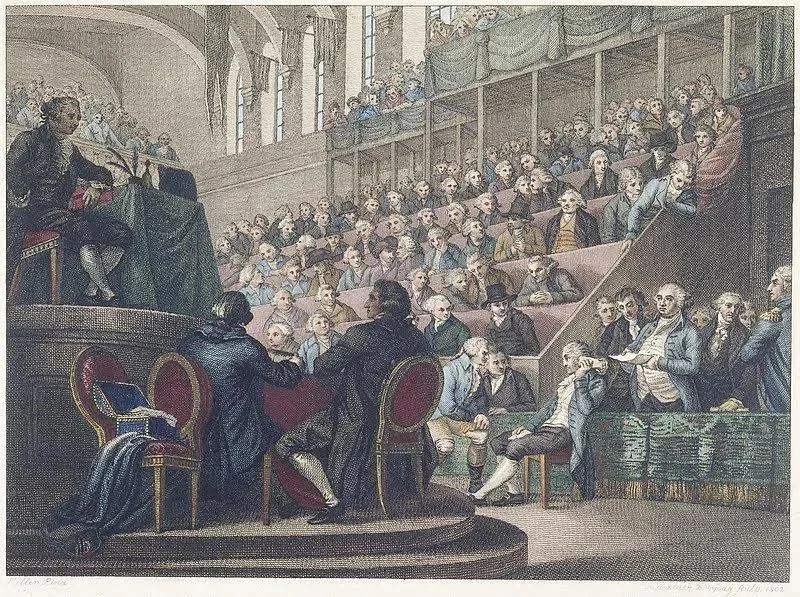
Figure 1. The trial of King Louis XVI of France, 1792; engraving by Reinier Vinkeles, c. 1793-96. King Louis XVI is seen in the lower right, holding a sheet of paper from which he reads his defense.
The diffusion of Voltaire, Diderot, and d’Holbach’s skeptical religious thought can be examined through events that reflect the growing intolerance toward Christianity during the French Revolution. A pivotal event that depicts a shift in the French populace’s perception of Christianity was the abolition of the French monarchy’s divine right to rule. On September 21, 1792, the French National Convention proclaimed the abolition of the French monarchy. [17] King Louis XVI was eventually convicted of treason by the French National Convention for refusing to revoke his power and was guillotined in 1793, putting an end to divine right rule in France. [18] According to S. Barnett, “Parlement’s defiance and the declarations of its rights to represent the nation were of course seen as dangerous invitations to challenge the political status quo of France and orthodox Catholicism…Parlement was asserting what it saw as its right to save France from despotism and reassert its noble political and material rights.” [19] The French National Convention aimed to replace the divine right of kings with the supreme sovereignty of the nation.
Voltaire had welcomed the new political reforms that he observed in England, which caused him to question the validity of the concept of divine right. Voltaire did not abandon support for monarchy as a whole, but he did believe “...a just government should include a king whose powers are limited by the rule of law rather than upheld by a divine power.” [20] In England, the King and Parliament had asserted control over the church,,“There is hardly a bishop, a dean, an archdeacon, who does not think he holds his position by divine right; it is therefore highly mortifying to them to have to acknowledge that they owe everything to a miserable law made by profane laymen.” [21] Here Voltaire points to the absurdity of a “miserable law” in which the Church that enunciates the doctrine of divine right draws its authority from the very king that it has declared divine.
Diderot’s denunciation of divine right was centered around his belief that no person has received the right from a higher supernatural power to command others. According to Lester Crocker, Diderot argued in his article "Obéissance” that “one does not receive legitimacy to command from God.” [22] The foundation of Diderot’s rejection of divine right stems from his skepticism of the existence of a God, as articulated in the Letter on the Blind. Authority, he argued, could not be granted by something outside of the realm of the senses. [23] Similarly, in “Political Authority,” Diderot emphasized that if there is a God, he would’ve intended authority of power to have been delegated “with reason and proportion and not by blindness and without reservation.” [24] From Diderot’s perspective, the concept of divine right to rule is not based on reason nor religion itself but on mankind’s blind subordination to religious institutions.
While d’Holbach didn’t focus his arguments directly on divine right, he emphasized his skepticism toward God. For instance, Kors notes how d’Holbach most likely rejected the concept of divine right on the premise that God is a fabrication of the human mind and is “not composed of the physical matter that obeys the laws of Nature.” [25] D’Holbach wrote in Systems on Nature that man “formed gods of the most preposterous and ridiculous kinds: these became the sole objects of his hope, and the creatures of his fear.” [28] D’Holbach denounced divine right based on his theory that God is a fabrication of the human mind rather than a figure that actually exists and actively intervenes in the universe.
The influence of Voltaire, Diderot, d’Holbach and other religious skeptics and atheists on the French National Convention was evident in the actions taken to abolish the absolute monarchy and divine rule, and to severely undermine the authority of the Catholic Church.[29] In so doing, the revolutionaries acted in line with Voltaire’s denunciation of divine right and opposition to absolute monarchy. Crocker argues thatDiderot’s perception of divine right “attracted the most attention because of the scandal and controversy it provoked” between the National Convention and those who were loyal to the king.[30] Diderot’s opinion in “Political Authority” that legitimacy is derived from the nation’s people rather than God was clearly reflected by the National Convention in their efforts to overthrow the monarchy and established an elected representative government in its place.[31] D’Holbach’s denunciation of the existence of God also resonated with the French bourgeoisie, who dominated the National Convention and Constituent Assemblies. [34] The bourgeoisie blamed King Louis XVI and the monarchy for “plunging France into economic turmoil.” [32] Their resentment against the king and the landed aristocracy also caused many to turn away from the long-rooted religious ideals which had upheld the King’s power for centuries and to turn to Enlightenment thinkers like Voltaire, Diderot, and d’Holbach. [33]
The Undoing of the Catholic Church’s Authority in Revolutionary France
During 1789 and 1790, the National Constituent Assembly aimed to deconstruct the power and influence of the Catholic Church in France, making the Church subordinate to the French revolutionary government. On October 10, 1789, the National Constituent Assembly passed a declaration that “seized all properties and land held by the Catholic Church” and eventually outlawed “monastic vows taken by monks and nuns” in February of 1790. [35] By July of 1790, the National Constituent Assembly published the Civil Constitution of the Clergy which limited the number of bishops and insisted that all clerics were to be elected by the people of France. [36] Similarly, people in France who were against the establishment of the Catholic Church transformed the Church into Cults of Reason. [37] Historians have attributed the dechristianization and deconstruction of the catholic Church’s authority in France to the diffusion of anti-catholic ideals from the French Enlightenment. Specifically, Voltaire, Diderot, and d’Holbach expressed views that denounced the powerful institution of the Catholic Church within their various works.
Voltaire’s satirical novel Candide and his “Letter on the Church of England” drew attention to the abuse of power that the Catholic Church wielded over European society. Stephane Pujol argues that Voltaire sought to highlight the “illogical” construct of power that was exhibited by the Catholic Church and to assert that “there is hardly a system about one can speak without laughing.” [38] Voltaire satirized the institution of the Catholic Church in Candide by describing an extreme circumstance for the ordering of an auto-da-fe: “...they had seized on a Biscayner, convicted of having married his godmother, and on two Portuguese, for rejecting the bacon which larded a chicken they were eating; after dinner, they came and secured Dr. Pangloss, and his disciple Candide, the one for speaking his mind, the other for having listened with an air of approbation.” [39] Candide’s torture for “listening with an air of approbation” exemplified the abuse of power Voltaire believed the Catholic Church asserted over European society. In “Letter on the Church of England,” Voltaire contrasted the lack of corruption in the Church of England to highlight the corruption behind the Catholic Church of France: “With regard to the morals of the English clergy, they are more regular than those of France, and for this reason. All the clergy are educated in the Universities of Oxford or Cambridge, far from the depravity and corruption which reign in the capital.” [40]
Diderot denounced the Church’s dogmatism which he believed prohibited the freedom of religion and thought. According to Kors, Diderot believed that religious dogmas “interfered with the natural development of the human passion.” [41] In “Political Authority,” Diderot drew attention to the fact that fear of illegitimacy and self-interest are what drive the corrupt conduct of the Catholic Church and the absolute monarchy: “Fear and self-interest are the motives of their conduct.” [42] In other words, Diderot depicted institutions like the Catholic Church as powerful, unaccountable, and self-interested modes of authority secured through religious dogma. d’Holbach’s Christianity Unveiled likewise emphasized how the Catholic Church had corrupted mankind. “The vulgar, busied in the labours necessary to their subsistence, place a blind confidence in those who pretend to guide them, give up to them the right of thinking, and submit without murmuring to all they prescribe…It establishes to itself in every state a separate power, and becomes the tyrant or the enemy of every other power.” [43] D’Holbach asserted that the Catholic Church as a “separate power” had become an instrument for tyranny. “The Christian religion,” he concluded, “ is but a rotten prop to morality.” [44]
Kselman emphasized that what motivated the Assembly to deconstruct the power of the Church was the “abuse of its religious authority” over sections of French life that were not linked to religion. [45] The National Constituent Assembly abolished the Church’s economic authority to collect taxes in 1789 since it only benefitted the Church’s “powerful and influential hierarchy” rather than the poorer sectors of society. [46] In 1790, the National Constituent Assembly published the Civil Constitution of the Clergy, an action widely seen as influenced by Diderot. According to Kselman, the Civil Constitution of the Clergy limited the number of bishops allowed in the Catholic Church and insisted that all clerics were to be “elected by the people of France.” [47] D’Holbach’s atheism was similarly asserted by members of the Cult of Reason who decided to seize churches and convert them to Temples of Reason. According to Irving Louis Horowitz, people in Revolutionary France rallied behind the Cult of Reason in the interest of phasing out the ways of the Catholic Church in French society. [48] “The cults… represented a radical new solution to the centuries-old European dilemma of the Catholic Church…the cults viewed Old Regime Catholicism as a barrier to their comprehensive vision for revolutionary France.” [49] One of the main “visions” of the Cult of Reason that Horowitz expresses was the establishment of a “support system” that the French people could rely on. [50]
Anticlericalism During the September Massacres and the Reign of Terror
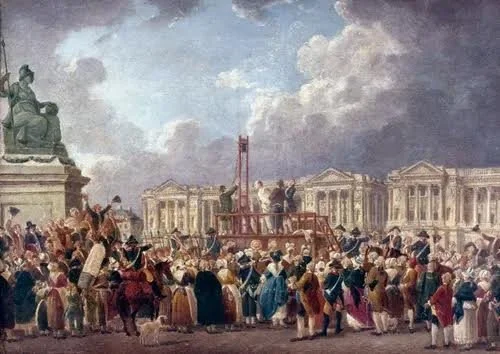
Figure 2. An execution by guillotine during the Reign of Terror in Une Exécution capitale, place de la Révolution. Oil painting mounted on canvas by Pierre-Antoine Demachy, c. 1793; in the Carnavalet Museum, Paris.
On September 2, 1792, a five-day massacre of prisoners took place in Paris. Of the 1,200 prisoners that were killed, more than 220 of them were priests. [52] According to Clifford Conner, the priests were killed by the revolutionaries for refusing to accept the Civil Constitution of the Clergy. [53] About a year later, on September 5, 1793, the gruesome and violent Reign of Terror struck France and persisted until July of 1794. [54] During this period, Maximillian Robespierre ordered the execution of over 17,000 enemies of the revolution. [55] According to Barnett, of these 17,000 people, hundreds were members of the clergy. Anti-clericalism was at its ultimate height during the Reign of Terror throughout the French provinces, leading historians to link the atmosphere of anticlericalism to the diffusion of anti-clerical ideas from the French Enlightenment period, specifically those of Voltaire, Diderot, and d’Holbach.
In Candide, a powerful religious figure, known as the Grand Inquisitor, forces the character Cunegonde to sleep him. [56] High priests, such as the Grand Inquisitor, were bound to have taken a vow of chastity. [57] Voltaire’s depiction of the Grand Inquisitor going against his supposed duties displays the hypocrisy Voltaire believed existed among clerical members. Similarly, in his “Letter on the Church of England,” Voltaire draws attention to the hypocrisy of clerical members in France: “When they learn that in France young men, who are known for their debauchery and who have been raised to the prelacy by the plots of women, make love in public…entertain daily with long and exquisite supper parties, and go from there to beseech the light of the Holy Spirit, and boldly to call themselves the successors of the Apostles—then the English thank God they are Protestants.” [58] Voltaire believed that the clergy violated and betrayed the holy role they were supposed to fulfill in society.
In The Nun, Diderot told the story of a young girl who begins to live in a convent and is tortured by the Mother Superior and the other nuns. Told from the perspective of the young girl, she states regarding the Mother Superior, “...I thought I had to hide from her eyes.” [59] The abuse the young girl experiences, such as being stripped of her clothing and forced to walk on glass, displays Diderot’s intent to reveal venality of the clergy. [60] Similarly, d’Holbach’s atheism causes him to criticize the clergy in his book Christianity Unveiled. He refered to clergy members as "reverend wolves in shepherds’ clothing, under pretence of feeding with instruction, devoured with avarice, and, secure in their disguise, fattened on the blood of their flocks, unpunished and unsuspected.” [61] From d’Holbach’s perspective, members of the clergy are evil because they use society’s interest in God and the divine to their advantage of power. He also argued that Christianity was inter tolerant and thus given to conflict and social disorder: “Christianity creates intolerants and persecutors, who are much more injurious to society than the most abandoned debauchees.” [62]
The anticlericalism of Voltaire, Diderot, and d’Holbach contributed to the intellectual context in which members of the clergy and nuns were killed in the September Massacres and the Reign of Terror. Conner notes that “[a]lthough this vigilante action degenerated into an orgy of gratuitous violence, it had begun with a clear and rational purpose.” [63] Kors argues that both Diderot and d’Holbach’s resentment of religious figures was expressed by French people during the Reign of Terror. [65] Furthermore, Timothy Tackett argues how French revolutionary author, Rosalie Jullien, expressed extreme hatred towards the clergy during the Reign of Terror. Jullien states, “...the black evil of the aristocrats, the fanaticism of priests, the atrocious pride of the nobles. . . . All those who oppose the public good are, in my eyes, enemies and monsters.” [66] In other words, people during the Reign of Terror, like Jullien, sided with Robespierists in executing priests since they viewed priests as jeopardizing the good of society.
Conclusion
Ultimately, the diffusion of Voltaire, Diderot, and d’Holbach’s skeptical religious thought in France influenced French society’s perception of Christianity during the French Revolution through the abolishment of the French monarchy’s divine right to rule, the political deconstruction of the Catholic Church’s authority in France, and the anticlericalism exhibited during the September Massacres and the Reign of Terror. The early philosophical works of these French Enlightenment thinkers laid the groundwork for their later rejections of divine right, the power of the Catholic Church, and members of the clergy. Therefore, the religious skepticism exhibited by these three philosophers aided in the revolutionary overthrow of the authority the Catholic Church and thus inaugurating a new era in France.
Endnotes:
Voltaire. Letters on the English. England: Cassell & Co, 1894; Project Gutenberg, April 22,
2005. https://www.gutenberg.org/files/2445/2445-h/2445-h.htm
Voltaire. “Poem on the Lisbon Disaster.” New York: G.P. Putnam's Sons, 1912; Whitman People,
2012. http://people.whitman.edu/~iversojr/Candide/lisbon.htm
Voltaire, “Poem on the Lisbon Disaster,” 3.
Voltaire. Candide. New York: Boni and Liveright, 1918; Project Gutenberg, November 27, 2006.
https://www.gutenberg.org/files/19942/19942-h/19942-h.htm
Voltaire, Candide, 35.
Wade, Ira O., and Voltaire. Voltaire and Candide: A Study in the Fusion of History, Art, and
Philosophy. Princeton, N.J: Princeton University Press, 1959.
Lester G. Crocker, “Diderot as a Political Philosopher,” Revue Internationale de Philosophie 38,
no. 148 (1984):12. http://www.jstor.org/stable/23945304.
Denis Diderot, Letter on the Blind (Chicago and London: The Open Court Publishing Company, 1916), 106. http://tems.umn.edu/pdf/Diderot-Letters-on-the-Blind-and-the-Deaf.pdf
Diderot, Letter on the Blind, 107.
Denis Diderot, “Political Authority,” In Encyclopédie ou Dictionnaire raisonné des sciences, des arts et des métiers (Paris, 1751); (Ann Arbor: Michigan Publishing, 2009) 6. https://quod.lib.umich.edu/d/did/did2222.0000.062/--political-authority-abridged?rgn=main;view=fulltext;q1=Denis+Diderot
Denis Diderot, The Nun, (Paris: Garnier Frères, 1875); Project Gutenberg, January 5, (2021), 10. https://www.gutenberg.org/cache/epub/28827/pg28827-images.html
Alan Kors, D’Holbach’s Coterie: An Enlightenment in Paris, (Princeton, New Jersey: Princeton University Press, 2015) 3.
Paul Henri Thiry d’Holbach, Christianity Unveiled, (London, 1819); Project Gutenberg, September 17, (2012), 10. https://www.gutenberg.org/cache/epub/40770/pg40770-images.html
d’Holbach, Christianity Unveiled, 13.
Paul Henri Thiry Holbach, The System of Nature, ( New Jersey: Princeton Univ. Press, 1938);
Project Gutenberg, June 7, (2013), 2. https://www.gutenberg.org/files/8909/8909-h/8909-h.htm
Holbach, The System of Nature, 3.
S. Barnett, The Enlightenment and Religion: The Myths of Modernity, (Manchester: Manchester
University Press, 2004), 5.
Barnett, The Enlightenment and Religion, 6.
Barnett, The Enlightenment and Religion, 67.
Wade, Voltaire and Candide, 78.
Voltaire, “Letter on the Church Of England,” 6.
Crocker, “Diderot as a Political Philosopher,” 123.
Diderot, Letter on the Blind, 2.
Diderot, “Political Authority," 1.
Kors, D’Holbach’s Coterie: An Enlightenment in Paris, 80.
Kors, D’Holbach’s Coterie: An Enlightenment in Paris, 83.
Kors, D’Holbach’s Coterie: An Enlightenment in Paris, 90.
D’Holbach, The System of Nature, 3.
Barnett, The Enlightenment and Religion, 282.
Crocker, “Diderot as a Political Philosopher,” 150.
Crocker, “Diderot as a Political Philosopher,” 150.
Kors, D’Holbach’s Coterie: An Enlightenment in Paris, 188
Kors, D’Holbach’s Coterie: An Enlightenment in Paris, 190
Kors, D’Holbach’s Coterie: An Enlightenment in Paris, 192
Thomas Kselman, “Challenging Dechristianization: The Historiography of Religion in Modern
France,” Church History 75, no. 1 (2006): 133. http://www.jstor.org/stable/27644715.
Kselman, “Challenging Dechristianization,” 134.
Irving Louis Horowitz, “Cult of Reason and Cries of Rage,” Society 48, no. 3 (2011): 259. doi:https://doi.org/10.1007/s12115-011-9427-6. https://libdb.fairfield.edu/login?url=https://www.proquest.com/scholarly-journals/cult-reason-cries-rage/docview/861080997/se-2.
Stéphane Pujol, “Forms and Aims of Voltairean Scepticism,” In Scepticism in the Eighteenth
Century: Enlightenment, ( Dordrecht: Springer Netherlands, 2013) 193. https://doi.org/10.1007/978-94-007-4810-1_13.
Voltaire, Candide, 24.
Voltaire, “Letter on the Church Of England,” 8.
Kors, D’Holbach’s Coterie: An Enlightenment in Paris, 112.
Diderot, “Political Authority,” 1.
d’Holbach, Christianity Unveiled, 13
d’Holbach, Christianity Unveiled, 14
Kselman, “Challenging Dechristianization,” 140.
Kselman, “Challenging Dechristianization,” 142.
Kselman, “Challenging Dechristianization,” 142.
Horowitz, “Cult of Reason and Cries of Rage,” 260.
Horowitz, “Cult of Reason and Cries of Rage,” 261.
Horowitz, “Cult of Reason and Cries of Rage,” 261.
Horowitz, “Cult of Reason and Cries of Rage,” 261.
Clifford D. Conner “From the Champ de Mars Massacre to the September Massacres: July 1791 to September
1792,” In Jean Paul Marat: Tribune of the French Revolution, (Pluto Press, 2012), 243.
https://doi.org/10.2307/j.ctt183gzv8.
Conner “From the Champ de Mars Massacre to the September Massacres,” 245.
Timothy Tackett, The Coming of the Terror in the French Revolution. 1st ed, (Cambridge: Harvard University
Press, 2015), 101. https://doi.org/10.4159/9780674425163.
Tackett, The Coming of the Terror in the French Revolution, 155.
Voltaire, Candide, 35.
Barnett, The Enlightenment and Religion, 26.
Voltaire, “Letter on the Church Of England,” 7.
Diderot, The Nun, 16.
Diderot, The Nun, 13.
d’Holbach, Christianity Unveiled, 13.
d’Holbach, Christianity Unveiled, 28.
Tackett, The Coming of the Terror in the French Revolution, .
Conner “From the Champ de Mars Massacre to the September Massacres,” 247.
Conner, “From the Champ de Mars Massacre to the September Massacres,” 247.
Tackett, The Coming of the Terror in the French Revolution, 256.

Brianna McAleer
Brianna McAleer is a J.D. Candidate at St. John's University School of Law. She earned her B.A. in History with minors in Politics and English from Fairfield University. Much of her research explores the relationship between religion and the political/legal framework of societies throughout history. In her free time, she runs The East Coaster Magazine, where she leads a team of writers, producing content based on wellness, activity, and nature from across the East Coast.