
Quaestio mihi factus sum: Death, Friendship, and the Construction of Identity in the Confessions
Introduction
In his Confessions, Augustine asks, “What then am I, my God? What is my nature? It is characterized by diversity, by life of many forms, utterly immeasurable.”[1] Augustine’s identity can be understood as malleable and not fixed. His life and selfhood are a vast portrait of never-ending metamorphoses, painted in the medium of love—of God and neighbor. His Confessions shifted the conception of identity from a public matter to a personal one through an intimate self-portrait.[2] It is within this framework that scholars such as Frank Vander Valk[3] and Fred C. Alford[4] have understood Augustine’s life and writings as deeply contemplative with inward reflections and meditations on broad ideas like wisdom, love, and God. I argue that the people in his life shaped the development of his ideas and selfhood just as much as his relationship to God. In this paper, I argue that throughout Augustine’s life, his self-understanding is influenced by friends within a larger network of relationships. By focusing on the themes of death and friendship in Augustine’s writings, I hope to illuminate what friendship meant to him, especially when it was lost; ultimately, I hope to reveal how these figures brought Augustine closer to God and shaped his understanding of himself.
In 354 CE, Aurelius Augustinus was born in Thagaste – a small town and Roman municipium in North Africa. Born to a pagan father and a Christian mother, Augustine wrestled with his religion. At 16, he had a band of friends with whom he engaged in youthful fun. He was attracted to the Christian sect of Manichaeism (a dualistic view which combined Christian, Zoroastrian, and Gnostic doctrine), which, for Augustine, provided a seemingly secure knowledge of the world. He would go on to convert friends into this sect, and as he changed his beliefs, his friends would gravitate toward those same beliefs alongside him.
He became disillusioned with Manichaeism and turned away from it. Augustine would turn his sights to philosophy, until he would eventually convert to Catholicism. The pagan philosophers Cicero, Aristotle, and Plotinus would remain prominent in his thinking even after his conversion. He eventually became a professor of rhetoric in Thagaste, Carthage, Milan, and Rome. Augustine continued to make lasting friendships with figures like St. Ambrose, Verecundus, Possidius, and Marcellinus; who made significant contributions to Augustine’s spiritual development.
Augustine would go on to meet many people, write numerous works, and ultimately become the bishop of Hippo.[5] Throughout his life, Augustine had friends by his side; some friendships lasted longer than others, and some ended in tragic deaths. Augustinian scholarship has articulated how influential friendship was on Augustine’s personal and spiritual life, but few scholars have underscored the role of death in Augustine’s understanding of friendship and his identity. Studies of Augustine’s friendships have thus far centered on Alypius and Nebridius, whom Peter Brown characterizes as “Augustine’s two deepest friends.”[6] Friends offered innumerable ways of accessing the self. In the following sections, I will explore the influence of classical notions of friendships on Augustine, the deaths of important figures in Augustine’s life, and how friendship is discussed in his correspondences and sermons. In a chronological organization, I will survey the development of Augustine’s ideas about friendship, primarily using Confessions, with additional treatment of non-canonical writings.
Friendship in the Confessions: What Would You Do for a Friend?
Augustine recounts a memory from his adolescence when he and his peers stole fruit from a pear tree. In an evocation of Eve and the forbidden fruit, the bishop analyzes his motivations and the sources of pleasure that informed his sin. He notes that it was only the nature of being forbidden that drove him and his companions to commit the theft.[7] At this moment, he also reflects on the problem of friendship as it can drive people to make concerted efforts toward vice. Although he recounts this memory from around 27 years earlier, he writes that he would not have participated in the act if it were not for his friends with whom he would be doing it.[8]
At the beginning of this Book, he writes that “The single desire that dominated my search for delight was simply to love and be loved.”[9] In this proclamation, we are confronted with the rudimentary conception of friendship that Augustine had as a child. Augustine’s early experiences with his peers proved to be malformed friendships, possibly built on like-mindedness but not virtue. This lack of virtue complicates the friendship, making it insufficient and limited.
The bishop writes, “Human friendship is also a nest of love and gentleness because of the unity it brings about between many souls.”[10] Unity, as it is integral to Augustine’s notion of friendship, must also be paired with virtue in God. Augustine would later refine his vision of friendship as one part of a larger hierarchy of relationships. Augustine laments his youthful folly, questioning whether he would have sinned were it not for the presence of his friends. He concludes the episode by warning that friendship can be a “dangerous enemy, a seduction of the mind,” beyond one’s understanding.[11] As significant as friendship is in Augustine’s thought, he will be wary of the hypnotic powers of people he holds dear.
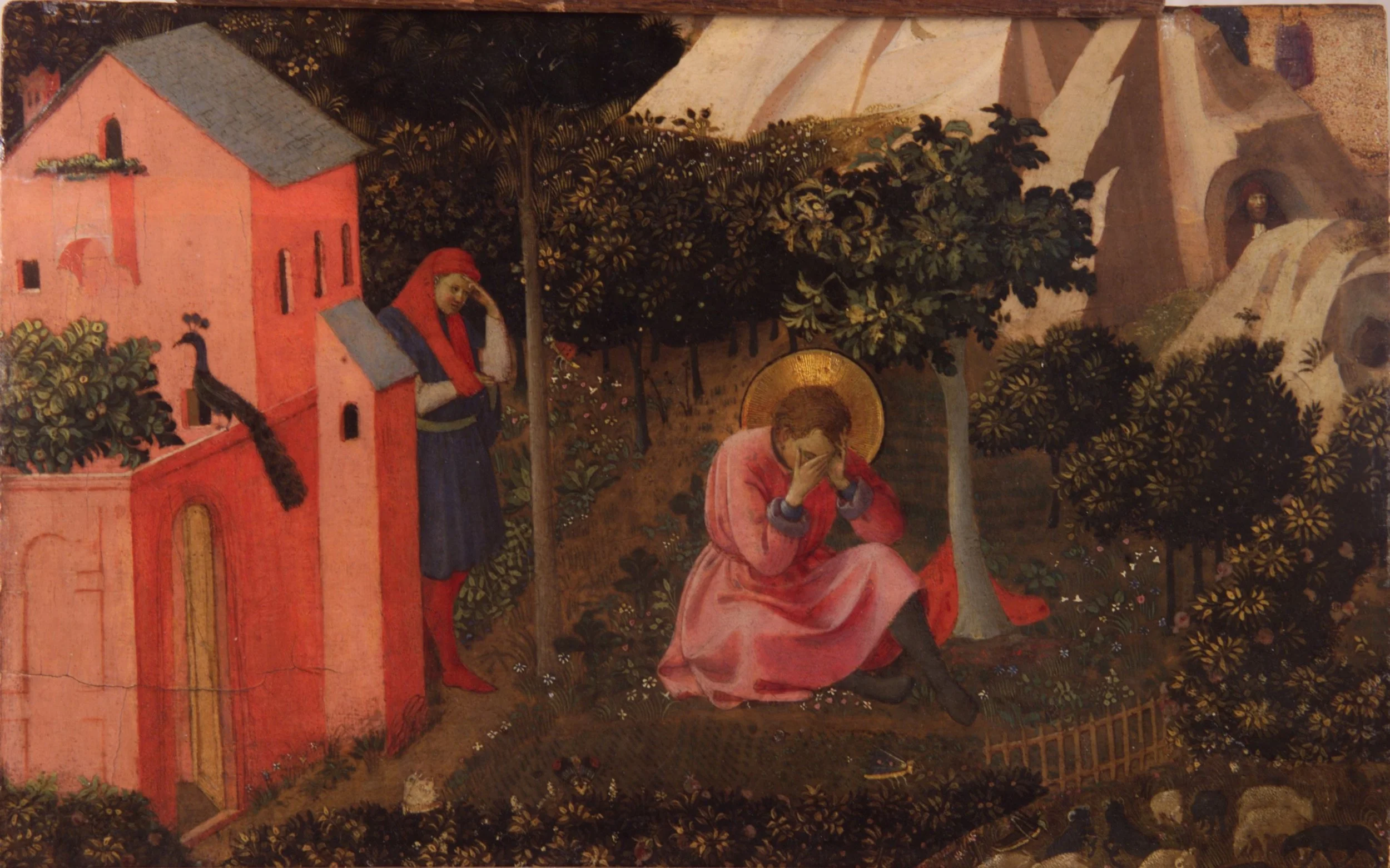
Figure 1. Conversion of Saint Augustine. Painting. Wikimedia Commons. https://commons.wikimedia.org/wiki/File:Fra_angelico_-_conversion_de_saint_augustin.jpg
One Soul in Two Bodies: When a Friend Dies
A pivotal moment in Augustine’s life, although acknowledged only marginally compared to the rest of the Confessions, is the death of Augustine’s unnamed friend in Book 4. The intimate display of grief and love for his friend is hauntingly vivid. It is as transformative a moment as any other metamorphosis that Augustine experiences. I will examine this episode and two other sources to show how Augustine emphasizes physicality in his language to explain his grief for his friend and how these reflections complicate Alford’s and Valk’s claim that friendship had no inherent place in Augustine’s identity.
At this point in the Confessions, Augustine has returned from Carthage to Thagaste, having become a Manichee. The year is 376 CE, and Augustine is only 22 years old. Augustine characterizes this period between the ages of 19 and 28 as “seducing and being seduced, deceiving and being deceived.”[12] As the bishop of Hippo looks back on this time, he sees himself as being hopelessly in pursuit of material ends. Earning a living by teaching rhetoric to sons of wealthy Romans, consuming public entertainment, and sleeping with a woman to whom he was not married, Augustine looks back on his inclination toward lewd activities.[13] His friend’s death will turn his friendship into another example of his misguided attachment to the material world. It is the death of this friend that creates such a tumult in Augustine’s inner world that he will flee to Carthage.
His friend, about whom we do know very little, is someone whom Augustine grew up with in Thagaste but became close with after he moved back from Carthage. This friend, who had “no strong or profound allegiance,” had converted to Manichaeism because of Augustine.[14] Similar to Augustine, he was a Manichee who came from a Catholic family. They were a pair of outsiders who had found commonality with each other. Augustine writes that “he wandered, in his soul, along with me; and my soul could do nothing without him [mecum iam errabat in animo ille homo, et non poterat anima mea sine illo].”[15] Augustine laments the scale of his grief brought on by his friend’s death, and credits it to the powerful attachment he had formed with his friend. One may recall Aristotle’s idea of a second self here. Augustine writes that it was at this friend’s death that “I had become a great question to myself [factus sum ipse mihi magna quaestio].”[16] Thus marks the metamorphosis of a young adult who in his indulgence of pleasure and ambition for social status, became disenchanted by the loss of his dear friend whom he had considered “a better and more real person than the [Manichee] phantom in which I would have been telling my soul to trust.”[17] This transformative language marks the blending of identities between Augustine and his friend. As his friend transitions from life to death, so does Augustine transition from a self-assured young man to an estranged drifter.
Valk argues that in its formulation, Augustine’s inner self “loses its inherently social character.”[18] But this shattering of self, or rather transformation of identity into an uncertainty, represents a remarkable shift in Augustine’s self-knowledge and is brought about by the death of a friend. If an external agent, apart from God, who did not even adhere to Catholic Orthodoxy,
could cause a turning of character such as this, the claim that friendship formed no fundamental part of Augustine’s identity becomes less believable. Even as an established Catholic bishop, Augustine looks back on this event and writes that “the lost life of those who die becomes the death of those still living [et ex amiss vita momentum mors viventium.]”[19] Decades later, the ex-Manichee recognizes others' influence on one’s sense of self, which is expressed in the parallel he draws between the death of a loved one and the one who mourns him. The conceptual understanding of grief in this section is transformed into physical language to explain how tethered two friends are even in death.
In another example, he expresses the laborious toils of grief: “I carried my lacerated and bloody soul when it was unwilling to be carried by me. I found no place where I could put it down.”[20] Augustine imagines himself as carrying a dying version of himself, weak and bloodied, and a great burden to Augustine, who aimlessly carries it around but is reluctant to walk away from it. In this striking imagery, Augustine again presents the physicality of intangible ideas; moreover, the physical separation or distinction he draws between himself and another part of himself. Fittingly, Augustine quotes Horace and Ovid who express the same sentiment: “Someone has well said of his friend, ‘He was half my soul.’ I had felt that my soul and his soul were ‘one soul in two bodies.’”[21]
Augustine writes that the reason why the death of his friend shook him so was because he had “poured out [his] soul onto the sand by loving a person sure to die as if he would never die.”[22]
What did Augustine mean by loving someone as if they would never die? Augustine knew death was a natural part of life and inevitable, but his obliviousness is rooted in a different sort of revelation. Thomas Carlson, a scholar of religion and philosophy in Christianity, writes that Augustine’s folly arose from a “self-deceiving enjoyment of the everyday existence he shared with the friend…went unseen while nonetheless grounding and shaping that enjoyment all along.”[23] Augustine’s world is constructed and reaffirmed as he spent time and developed affection with his friend. His perception of his life became warped by the many pleasures that it brought. His “world,” as he knew it, collapsed. Augustine’s identity should be understood not as a fixed, coherent, and stable one but a variable and diverse composition.[24]
Augustine reflects: “[Misery] is the state of every soul overcome by friendship with mortal things and lacerated when they are lost,” and in the next breath he writes, “I was more unwilling to lose my misery than him…I suppose that the more I loved him, the more hatred and fear I felt for the death which had taken him from me.”[25] It is clear that the friend’s death shakes Augustine on at least two levels: an emotional and an existential level. The emotional level exists in the context of his love for his friend, and the existential level exists in the context of how his grief prompts contemplation on his own mortality. In this regard, love is present in both levels and ricochets between Augustine’s inner and outer worlds. These levels are thoroughly enmeshed with each other, indicating that the love of his friend is tied to the love of himself, and that the death of one triggers a concern for the other. Both levels constitute the instability in Augustine’s identity and thus both become possible agents of reconstructing a stable identity. This is to say, a rightly ordered love grounded in God will allow him to achieve more stability in his identity in comparison to his early life, yet his sense of self remains unclear to him throughout his life.[26]
As a central tenet of Augustine’s theology, love is also a means by which we can examine how identity and the self are understood. In question thirty-five of his Eighty-Three Different Questions, Augustine writes that “Love is a kind of motion, and since there is no motion except toward something, when we seek what ought to be loved we are looking for something to which this motion ought to direct us.”[27] Augustine begins with a claim that love is a form of motion, always in a state of directed movement. He then deduces that love should direct us towards the things we ought to love. Thus, for Augustine, love is both a means for direction and the end goal.
In On the Morals of the Catholic Church, Augustine writes that to love one’s neighbor as oneself, “You must make him love God with perfect love; for you do not love him as yourself if you do not manage to lead him to the good which is your goal, too.”[28] Because God is the goal which one should be guided toward, God is the end, and love is the means. It is the love of neighbor and love of self that drives Augustine toward God. Love of neighbor becomes a medium through which Augustine achieves the end, which is God. As he concludes Book 4, he tells his readers, “If souls please you, they are being loved by God; for they also are mutable and acquire stability by being established in him… In him therefore they are loved; so seize what souls you can to take with you to him.”[29] As the mature Augustine writes, his notion of friendship is presented as being inherently sourced from God. The virtues he recognizes in his friends are virtues that are given by God, and they are virtues that are only recognizable because they are present in Augustine as well.
The next objective is to underscore how loving God allows Augustine to know himself. God is the maker of the universe, and so God has made all creatures, including humans, both Christian and not. After the death of his friend, Augustine returns to Carthage, and he begins Book 5 with a reflection on his blindness, which kept him from God for years: “You alone are always present even to those who have taken themselves far from you.”[30] The path to God is encapsulated by existing and moving within a world where God is everywhere and the source of everything. The rejection of God signals the rejection of the world, humanity, and all the creations made beautiful in God, including the self. Augustine urges his readers to consider that God’s presence in their heart is due to the fact that he had made them and strengthened them.[31] As Augustine reflects on his own past deceptions, it seems that opacity of the self is a dominating theme in the early years of Augustine’s life.[32] In Augustine’s search for himself, he looks toward philosophy, toward Manichaeism, toward his friends, and finally toward God. It is in God that Augustine ultimately is “remade” when he realizes God is his maker, and it is through him alone that Augustine understands himself.
In Book Ten, he writes, “Accordingly, let me confess what I know of myself. Let me confess too what I do not know of myself. For what I know of myself I know because you grant me light.”[33]Augustine is humble regarding the fallibility of his knowledge. After years of self-deception, lust for ambition, and satisfying his vices, Augustine now recognizes how little he truly knows, and whatever he does know is because God has granted it to him. It is also God whom he finds when he finds himself. As a parallel to love, God is the means and the goal. Augustine asks God, “But when I love you, what do I love?”[34] He asks the sea, the winds, and the animals, to which they all reply that they are not the object of his love and cry out, “He made us!”[35] In an illustration of Augustine’s view of the world and God, he reveals, “My question was the attention I gave them, and their response was their beauty.”[36] Beauty is what marks the condition of being made by God. It is for the sake of God that he loves his friends. But it is the essence of God that is present in his friends and in all of God’s creations, that he loves. This dwelling-place of God within himself and all people remains an inherent part of Augustine’s conception of his own identity. Thus, it is safe to say that Augustine’s identity is mediated through God and toward God, but one may miss the steppingstones of friends and love of neighbor, which provide a clearer path to God from the individual.
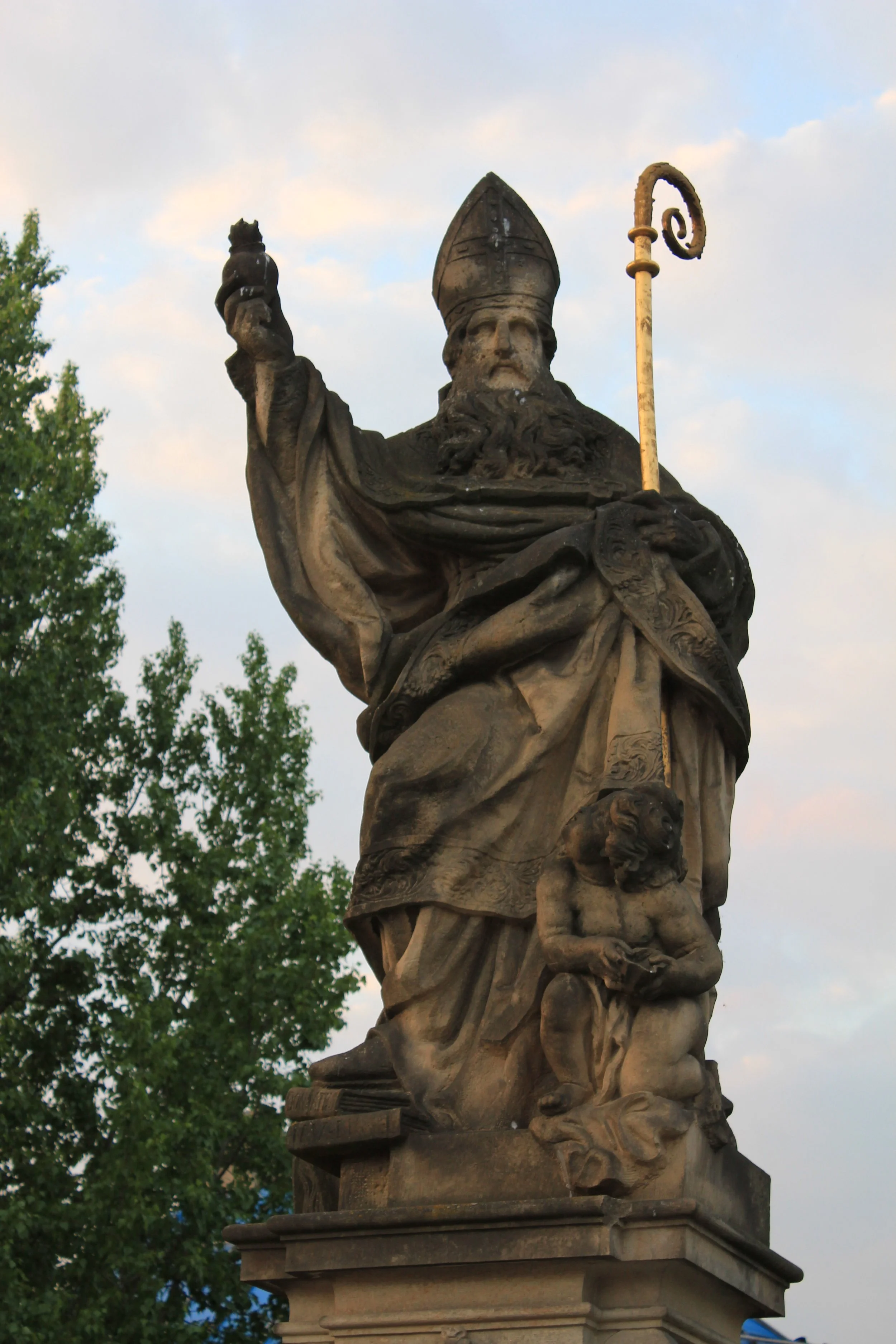
Figure 2. Statue on Charles Bridge, Prague. Photograph. Wikimedia Commons. https://commons.wikimedia.org/wiki/File:Prague_Praha_2014_Holmstad_Statue_på_Karlsbrua_2.jpg
Alypius and Nebridius: What Can You Learn from a Friend?
Two figures stand out among the various people in Augustine’s life—Alypius and Nebridius. These men have been at the side of their great friend for as long as they have known him. Alypius and Augustine grew up in Thagaste, and they became friends when Alypius was Augustine’s rhetoric student in Thagaste. Augustine writes of him, “He was much attached to me because I seemed to him good and cultured, and I was attached to him because of the solid virtue of his character, which was already apparent when he was of no great age.”[37] In his early perception of Alypius, Augustine recognizes a virtue in his student and clings to that goodness which never wavered throughout their lives so long as they were intertwined.[38] In each other, they recognized a good and were attracted to that good, fostering a close bond between the pair. Much like the conceptions of both classical and Christian friendship discussed above, this example appears as a dazzling account of two kindred souls meeting and forming a friendship grounded in mutual affection for each other’s virtues.
Indeed, Alypius remained a moral beacon and model, while Augustine had often felt inferior to him in comparison. Since he was a boy, Augustine found continence a difficult endeavor. His lust for women had been a great source of shame and, necessarily, self-reflection. Augustine’s friends were not only sources of comfort, but also inspirations for a better version of himself. He saw the good in them and wanted to share in that goodness. This matter of incontinence stresses that aspect of friendship in Augustine’s life. Alypius was unwavering in his abstention from sexual activity. While Augustine notes that his friend had had a sexual experience when he was a boy, Alypius “felt a revulsion for it,” living in “total continence,” thereafter.[39] The bishop recounts Alypius’ reasoning: “His theme was that, if I did that, there would be no way whereby we could live together in carefree leisure for the love of wisdom, as we had long desired.”[40] The mutual love and pursuit of wisdom is what joined the two men together in concord, but when Augustine’s vice threatens to risk that shared endeavor, Alypius does not flee from his friend, instead he shifts his perspective, “He used to say that he wanted to know what it was without which my life would have seemed to me not life but torture.”[41] In the desire for single-mindedness, Alypius becomes curious about this onerous strife which his friend endures. His attempts at argument do little to sway Augustine, so Alypius considers the possibility of marriage not for the purpose of marital companionship or sexual pleasure, but solely to understand what pleasure his friend cannot abstain from.[42]
John J. Gavigan notes that Nebridius likely grew up near Carthage, born around 355 CE to a pagan family.[43] He likely met Augustine through schooling during Augustine’s tenure at Carthage. It is unclear whether Nebridius was ever a Manichean or had ties to the sect, but we learn that Nebridius was raised under the influence of docetic views, a heretical sect of Christianity which denied the humanity of Jesus.[44] We also learn that Nebridius had converted his household and others to Catholicism. While Augustine was at Cassiciacum and Ostia from 386 to 387 CE, Nebridius had to manage his family’s wealthy estate. As his duties managing his estate kept him apart from Augustine, Nebridius was also ill during this period and could not travel. In the Confessions, Nebridius’ death passes by subtly in a confusingly brief way. As Brown notes, this period, “is one of the most significant blanks in Augustine’s life.”[45] Monica dies in 386 CE, while his son, Adeodatus, and Nebridius die sometime shortly after that. Though he writes briefly on the death of his dear friend, his words are nevertheless poignant as he refers to Abraham’s bosom, commonly believed to refer to heaven, “Whatever is symbolized by ‘bosom,’ that is where my Nebridius lives, a sweet friend to me.”[46]
Though this portrait of loss is neither extensive nor emotionally overt, it is nevertheless significant. Whatever the circumstances that had led him to write such brief utterances, Augustine manages to capture well the love he had for Nebridius by eliciting his virtues. One quality of Nebridius that Augustine had admired and noted frequently is his insatiability for knowledge, often asking, or rather, challenging, people to defend their beliefs. When he would write to Augustine, he wrote extensively and with many questions.[47] The comfort of his intellectual curiosity being satisfied as he “puts his spiritual mouth” to God’s fountain and “avidly drinks,” “happy without end.”[48] Though Augustine may not have discovered complete happiness during his life on earth, he finds peace in knowing that Nebridius does in heaven. This peace is also derived from knowing that Nebridius will not forget Augustine: “Since you, Lord, whom he drinks, are mindful of us.”[49] The friendship of Augustine and Nebridius remains alive, and perhaps it is made more complete as two-thirds of the relationship now belongs to that eternal realm—those two parts being God and Nebridius. Augustine’s sense of self is thus unharmed when Nebridius dies, unlike the death in Book 4. Augustine is now able to be separated bodily from his friend yet remain himself. Knowing he is remembered in heaven by both God and Nebridius becomes a balm that strengthens him and immortalizes their friendship.[50]

Figure 3. Roman Ruins of Saint Augustine, Souk Ahras (Algeria). Photograph. Wikimedia Commons.https://commons.wikimedia.org/wiki/File:Roman_ruins_of_Saint_Augustin_Souk_Ahras_(Algeria).jpg
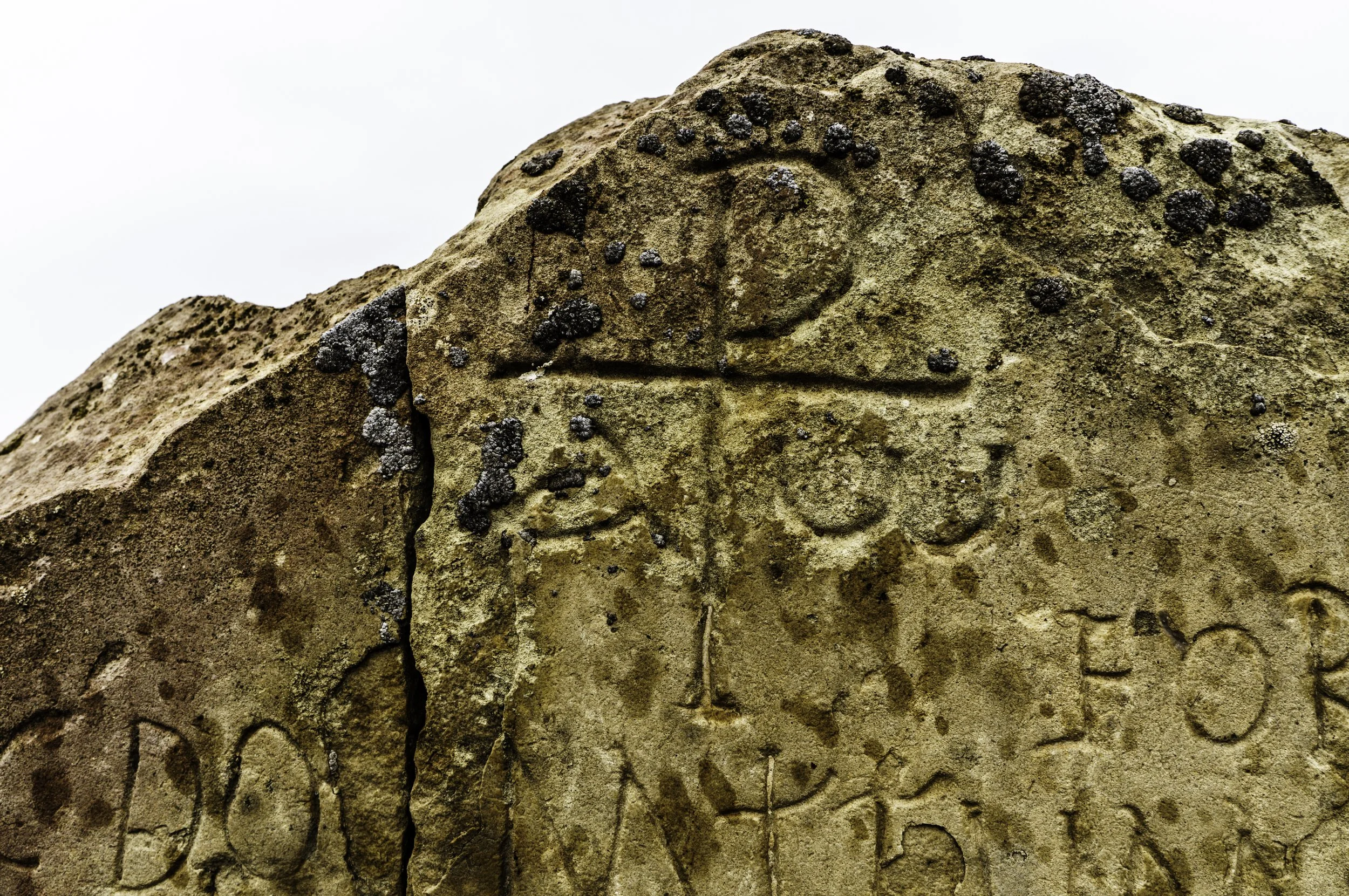
Figure 4. Thagaste (near Souk Ahras). Photograph. Wikimedia Commons. https://commons.wikimedia.org/wiki/File:Thagaste_(near_Souk_Ahras)_(15864358985).jpg
Monica – Mother, Friend, and Oracle of God [51]
Throughout Augustine’s childhood and adulthood, Monica came to be a fierce reminder of true faith and humility even after her death in 387 CE. A devoted Catholic, an overbearing mother, and a caretaker of enslaved people in Thagaste, the image of Monica appears with as much severity as grace. Monica was born into a North African Catholic family in 332 CE, being raised during the reign of Constantine the Great at a time when Christianity was burgeoning into a world religion. She recalls a memory of her nursemaid, who was likewise her father’s nursemaid.[52] This nursemaid, whom we can assume was a slave, was endowed with the responsibility of rearing the daughters of that Catholic household and teaching them proper Christian virtues. Monica recalls a memory of that unnamed woman who often prevented the girls from drinking water all day, aside from mealtimes, as an exercise in self-denial and nurture their resilience: “By this method of laying down rules for behavior and by her authoritative way of giving commands, she restrained the greedy appetite of a tender age.”[53]
Here, the picture of Monica’s upbringing clarifies the role of her life as Augustine’s mother. As a devout Catholic, when she heard of her eldest son’s conversion to Manichaeism, she wept deluges greater than the ones “mothers weep when lamenting their dead children.”[54] She would keep young Augustine from sleeping and eating in her home until she had a dream in which a young man advised her that Augustine would eventually turn to Catholicism. The man in the vision told her “to see that where she was, there was I also.”[55] Monica’s devotion to God is evidenced by being connected with her goal to see her son find that same devotion. After this vision, Monica’s anxieties for her son are soothed, but the task at hand becomes holding steadfast to the promised conversion of her son and remaining ever near him. She will continue to follow her son, even as he tries to trick her and flee to Rome without her.[56] She follows Augustine to Milan, where they meet St. Ambrose, who will be a figure of importance for both mother and son. At this point in the Confessions, Augustine has lost faith in Manichaeism but has not yet converted to Catholicism. Monica remained unsatisfied but determined to see her son accept the lord: “In her mind she was offering me before you on a bier, so that you could say, as you said to the widow’s son ‘Young man, I say to you, arise’ (Luke 7:12); and then he would recover and begin to speak and you would restore him to his mother.”[57] A monumental figure in Augustine’s faith, Monica is consistently the impetus by which Augustine is encouraged and challenged to seek out God and renounce his other beliefs and bad habits.
Conversely, God is present as Augustine writes about Monica and retroactively describes these memories. At the time, Augustine might not have believed God gave Monica a prophetic dream or led her to follow Augustine’s every footstep in the pursuit of converting him, but the bishop of Hippo retells the event as God’s will being mediated through Monica toward Augustine. Amid his ignorance of himself, Augustine addresses God, saying, “You were there before me, but I had departed from myself [et tu eras ante me, ego autem et a me discesseram nec me inveniebam.]”[58] Augustine’s identity is thoroughly shaped by God, but it remains necessary to acknowledge the people by whom he reached God.
After his conversion, Augustine writes, “the examples given by your servants…crowded in upon my thoughts” and how “they burnt away and destroyed my heavy sluggishness, prevented me from being dragged down to low things.”[59] In this reflection, we can assume Monica must be one of those servants whom he credits with such benevolence. Augustine describes God as saving him, but it is through Monica, among others, who plays a large role in his deliverance to God. What we can discern from Monica in the Confessions is that she was a woman whose steadfast dedication to God influenced and informed Augustine’s faith and how he arrived there. Though the path was tedious, Monica achieved her dream and saw Augustine converted to Catholicism.[60]
Only a year after his conversion, and only a year after seeing her vision come to fruition, Monica died in Ostia in 387 CE. In his reflections on this moment, Augustine again addresses God, “Another great gift with which you endowed that good servant of yours, in whose womb you created me, my God my mercy (Ps. 58: 18), was that whenever she could, she reconciled dissident and quarreling people.”[61] On one level, this passage underscores the value Augustine places on bringing people together. On another level, Augustine is always creating a space for God or for himself in his praises of Monica. The implications or agents involved in these remarks are often God or Augustine himself.
Before she died, Augustine and Monica held an intimate conversation together, discussing what the kingdom of heaven is like in comparison to the earthly world, “searching together in the presence of the truth which is you yourself.”[62] The exchange of ideas about the eternal is seen as an ascent toward God. This rising toward God is often a journey Augustine endeavors with someone else. Here, Monica and Augustine take a moment to dwell on a subject that they are mutually invested in and desire to know more about. The pursuit of wisdom, similarly, proves to be a durable aim and one that does not end when Augustine converts. “We ascended even further by internal reflection and dialogue and wonder at your works, and we entered into our own minds.”[63] Physical semiotics often arise in the Confessions, and here, Augustine imagines he and his mother entering their minds as if they were rooms. Augustine’s spatial language helps us understand how contemplation of God with another person forges both his own identity and a shared identity as both interlocutors enter their minds, which is to say that the exchange of thought is akin to a key that unlocks a corner of one’s identity. Here, Augustine can understand himself a little better, and this is only possible through three things: self, neighbor, and God. This discovery of self requires contemplation on God, and that reflection must be twofold—contemplation in solitude and contemplation with others.
Shortly after this moment, Monica contracted a fever, and on the ninth day, Augustine’s mother and most dedicated supporter of his turn to Christianity, rested forever. Yet again, grief meets Augustine as an overwhelming force which he attempts to suppress.[64] As a point of comparison to the death of Augustine’s unnamed friend, Monica’s death will offer a clearer picture of how his understanding of friendship changes from his Manichean period to his views as a Catholic. With the death in Book 4, Augustine’s love is carried away so far that the death stupefies him and hurls him into a crisis of uncertainty.
Monica’s death is equally, if not more, emotionally strenuous, and it takes great effort to pretend otherwise for Augustine. Initially, he reasons that “We did not think it right to celebrate the funeral with tearful dirges and lamentations,” because to do so was “to imply sorrow for the miserable state of those who die, or even their complete extinction. But my mother’s dying meant neither that her state was miserable nor that she was suffering extinction.”[65] Despite his assurance that Monica was in heaven, he remains at odds with his despair: “Why then did I suffer sharp pains of inward grief?... Now that I had lost the immense support she gave, my soul was wounded, and my life as it were torn to pieces, since my life and hers had become a single thing.”[66] It is because of how much he loves Monica that he cannot understand how to mourn her adequately while trusting that she is in heaven with God.
In this torment, Augustine imagines a blow to his soul to articulate how deeply her death had penetrated him and his life, that he had come to realize how enmeshed her life was with his. One is again reminded of the way he conceived of his friendship in Book 4, which is that his and Monica’s souls had become “one soul in two bodies.”[67] The bishop recounts his attempts to avoid meeting his anguish by spending time with others, discussing various subjects as if nothing had happened.[68] He felt it impossible to feel at ease in God’s mercy as he accepted Monica into his kingdom while ignoring the loss of the “service she rendered to [him].”[69] In this shame, a “two-fold sadness” afflicts his duty to love his neighbor and to love God, which appears to be mutually incompatible for Augustine in this moment.[70]
The saint was, nevertheless, a mortal at one point, fallible and weak. When he inevitably yields to the growing dirge of agony, it is only then that he can find solace: “I was glad to weep before you about her and for her, about myself and for myself… My heart rested upon [the tears], and it reclined upon them because it was your ears that were there.”[71] Augustine realizes that Jesus’ two commands are not truly incompatible because it is God’s mercy that forgives man’s weakness, and so his tears, which one may still criticize, do not flow in disbelief of Monica’s entrance into heaven but in confession of his own shortcomings to God. This release is not only about himself and his mother, but for the benefit of himself and his mother, all the while in the presence of God. Love of neighbor runs concurrently with love of God as he yields to his grief. In his surrender, he admits defeat against the nature of his condition, which is the condition of all humanity having died in Adam, that is to say, fallen.
Monica, Augustine’s mother and personal patron, often appears in the Confessions as a specter, like some phantom of a life Augustine could never live up to and could never have appreciated sufficiently. The loss of her life shakes Augustine’s sense of self, much like other deaths do, and he is confronted yet again with how entangled his life and his identity are with those of the people he loves and by whom he is loved. To love another so deeply, for Augustine, was often a self-reflexive act. He loved the good in another and loved it like the good in himself. This is evident in his relationships with his unnamed friend, with Alypius, with Monica, and with many others. After his conversion, this self-reflection never completely disappears. It only slightly moves away from the center to make room for God, who is the cornerstone of all his relationships and the source of all that is good in himself and others.

Figure 5. Consecration of Saint Augustine. Painting. Wikimedia Commons. https://commons.wikimedia.org/wiki/File:Jaume_Huguet_-_Consecration_of_Saint_Augustine_-_Google_Art_Project.jpg
Conclusion
By examining his writings in the Confessions, I have argued that Augustine’s understanding of friendship shaped how he recognized himself and God. The early and significant event of Augustine stealing pears with his gang of youths similarly demonstrates Augustine’s own ideas about the dangers of friendship, as he was led toward vice by his peers. Augustine’s friendships remained influential throughout his life as a youth, a Manichee, a Catholic, and a bishop. For Augustine, friends took on a sort of “second self,” as we saw his identity merge with that of his friend in Book 4. This event fundamentally changed Augustine, reminding him of his own mortality and the potential of total loss of the good. He fled to Carthage, and during his career as a professor of rhetoric, he maintained important friendships like that of Alypius and Nebridius. After his conversion, Augustine became better equipped to manage his grief. Though Augustine writes more substantively about Monica’s death than Nebridius’, he placed both of these deaths in the context of God. The bishop finds comfort in relating their virtues to God, whom he saw as the source of all that is good, including those virtues which he so admired. He was able to recognize what he could not with his unnamed friend—that friendship mediated through God and for God, as both the means and the end, is the most fulfilling and stable. It is through God alone that friendship, love, and death have meaning for Augustine because God is the creator of all creatures and virtues. God provides the depth from which Augustine can love completely and safely, without fear of absolute death, to improve a friend’s progress toward God, a journey that never ends and should never be undertaken alone.
Endnotes
2. Charles Taylor proclaims, “It is hardly an exaggeration to say that it was Augustine who introduced the inwardness of radical reflexivity and bequeathed it to the Western tradition of thought.” From Sources of the Self: The Making of the Modern Identity. Cambridge, Massachusetts: Harvard University Press, 1992, p. 131.
3. Frank Vander Valk explores the classical influences of the relationship between friendship and identity in the shaping of the Greco-Roman social and political world. He argues that the ancient model emphasized the polis or the republic over the individual, and that Augustine had changed this model as his writings, particularly the Confessions, shifted the primacy of the state over to the individual, making later models of democratic and liberal ideas possible. From “Friendship, Politics, and Augustine’s Consolidation of the Self.” In Religious Studies Vol. 45, No. 2 (2009), p. 125-146.
4. In his work that attempts to free the conception of selfhood from broader social obligations, Fred C. Alford argues that “For Augustine, the self knows itself only in terms of its relationship to God.” From The Self in Social Theory: A Psychoanalytic Account of Its Construction in Plato, Hobbes, Locke, Rawls, and Rousseau. Yale University Press: New Haven, Connecticut, 1991, 186.
5. Isidore of Seville, a 6th/7th c. Spanish bishop and scholar, famously noted, “The man who claims to have read all of Augustine is a liar.”
6. Peter Brown, Augustine of Hippo. Berkeley and Los Angeles: University of California Press, 1967, p. 56.
7. Conf. II, iv, 9.
8. Conf. II, ix, 17.
9. Conf. II, ii.
10. Conf. II, v.
11. Conf. II, ix.
12. Conf. IV, i.
13. Conf. IV, i-ii.
14. Conf. IV, iv.
15. Ibid.
16. Ibid.
17. Ibid.
18. Valk, Abstract.
19. Conf. IV, ix.
20. Ibid. “Portabam enim concisam et cruentam animam meam, inpatientem portari a me; et ubi eam ponerem non inveniebam.”
21. Conf. IV, vi; Horace, Odes I, 3.8; Ovid, Tristia IV, 4.72, respectively. “Bene quidam dixit de amico suo: dimidium animae suae. Nam ego sensi animam meam et animam illius unam fuisse animam in duobus corporibus.”
22. Conf. IV, viii.
23. Carlson, A. Thomas. “Mourning Places and Time in Augustine.” In With the World at Heart: Studies in the Secular Today. University of Chicago Press, 2019, 58.
24. There is certainly no denying that when Valk writes “the Christian self is coherent and unified in a way that the Greek self (Aristotelian or otherwise) is not, and this coherence is the result of individuals being creations endowed with an independent worth relative to one another,” he is entirely right in the context of comparing previous classical traditions of understanding the self (139). It is less convincing, however, when he argues both that the social sphere of Augustine’s life had no foundational role in the development of his identity and that Augustine’s identity was a stable and coherent one.
25. Conf. IV, vi.
26. Augustine’s identity wavered regardless of how strong his faith was: “In this matter I know myself less well than I know you. I beseech you, my God, show me myself so that to my brothers who will pray for me I may confess what wound I am discovering in myself,” Conf. X, xxxviii.
27. De diversis quaestionibus octoginta tribus, PL-40, From “Sant’Agostino,” http://www.augustinus.it/latino/ottantatre_questioni/index2.htm. “Deinde cum amor motus quidam sit, neque ullus sit motus nisi ad aliquid, cum quaerimus quid amandum sit, quid sit illud ad quod moveri oporteat quaerimus,” 35.1.
28. De moribus ecclesiae catholicae, from Nicene and Post-Nicene Fathers, First Series, Vol. 4. Edited by Philip Schaff. Revised and edited for New Advent by Kevin Knight. Christian Literature Publishing Co., 1887, http://www.newadvent.org/fathers/1401.htm. “Hoc est, ut etiam ipse perfecto amore Deum diligat. Non enim eum diligis tamquam teipsum, si non ad id bonum ad quod ipse tendis, adducis. Illud enim est unum bonum, quod omnibus tecum tendentibus non fit angustum,” 26.49.
29. Conf. IV, xii.
30. Conf. V, ii.
31. Ibid.
32. Ibid. He asks, “Where was I when I was seeking for you? You were there before me, but I had departed from myself. I could not even find myself, much less you.”
33. Conf. X, v.
34. Conf. X, vi.
35. Ibid.
36. Ibid.
37. Conf. VI, vii.
38. Regarding Alypius, James O’ Donnel writes, “He is Horatio to Augustine’s Hamlet.” From Augustine: A New Biography. New York City: HarperCollins, 2005, p. 104.
39. Conf. VI, xii.
40. Ibid.
41. Ibid.
42. Conf. IV, x. (My translation): “Such, then, was that man who clung to me and wavered with me in deliberation on what manner of life we ought to live” [talis ille tunc inhaerebat mihi mecumque nutabat in consilio, quisnam esset tenendus vitae modus.]
43. Gavigan, John. “St. Augustine’s Friend Nebridius.” From The Catholic Historical Review, Vol. 32, No. 1 (Apr. 1946), pp. 47-58.
44. Conf. IX, iii, 6.
45. Brown, 128.
46. Conf. IX, iii.
47. Ep. 98.8.
48. Conf. IX, iii.
49. Ibid.
50. Joseph Clair writes, “For it is the temporal good of genuine friendship that is the greatest foretaste of eternal good—the singular site where the unchangeable good appears within human existence.” Discerning the Good in the Letters and Sermons of Augustine. Oxford: Oxford University Press, 2016.
51. Brown brilliantly captures Monica’s essence in this brief description. Like Cassandra who had been given the power of foresight by Apollo, Monica has a dream prophesizing Augustine’s conversion to Catholicism. In this sense, she is abstracted to the figure of a divine messenger with ardent faith in her prophesy, 158.
52. Conf. IX, viii.
53. Ibid. Kate Cooper notes that “There was no way of knowing what a daughter might face in her married life. No one could guess from outside what took place behind the closed doors of another home. So the best strategy was to prepare a daughter to face hardship--and hold her ground when she needed to—quietly but firmly. Seen in this light, Monica's upbringing was perhaps harsh and challenging, but it was designed to make her invincible.” From “Monnica,” In Queens of a Fallen World: The Lost Women of Augustine’s Confessions. First edition. New York: Basic Books, 2023, p. 62.
54. Conf. III, xi.
55. Ibid.
56. Conf. V, viii.
57. Conf. VI, i.
58. Conf. V, ii.
59. Conf. IX, ii.
60. Conf. VIII, vii.
61. Conf. IX, ix.
62. Conf. IX, x.
63. Ibid.
64. Conf. IX, xii, 29.
65. Ibid.
66. Ibid, 30.
67. See note 25.
68. Conf. IX, xii, 31.
69. Ibid, 30
70. Ibid, 31. Full citation: “And because it caused me such sharp displeasure to see how much power these human frailties had over me, though they are a necessary part of the order we have to endure and are the lot of the human condition, there was another pain to put on top of my grief, and I was tortured by a two-fold sadness.”
71. Ibid, 33.



_(15864358985).jpg)

Tenzin Kunsang
Tenzin earned her BA in Classical and Near Eastern Religions and Cultures at the University of Minnesota, Twin-Cities. She is currently at the University of Pennsylvania’s Post-Baccalaureate program in Classical Studies. She is planning on pursuing Classical Archaeology in graduate school.