
Brushstrokes of Empire: The Chinese Language and the Foundations of Japanese Kingship
Abstract
Studies of the late premodern and early classical Japanese periods highlight the expansion of centralized power and the emergence of a growing elite, often borrowed extensively from their Chinese counterparts to the West. However, the discussion of Chinese language is often left out of consideration as a relevant piece of the larger puzzle. This project explores the construction of statehood in the early Asuka (538-710) and Nara (710-794) periods through the influence of the Chinese language itself. This study will analyze several law codes, edicts of both Tang and Nara emperors, and the official histories of both cultures as a process of understanding legitimization in ancient Japanese imperial courts. Through a comparative analysis of Chinese and Japanese legal frameworks, state historical narratives, and Confucian policies, the influence of the Tang Chinese was undeniably crucial to the justification of their Japanese counterparts, especially towards their domestic and foreign audiences.
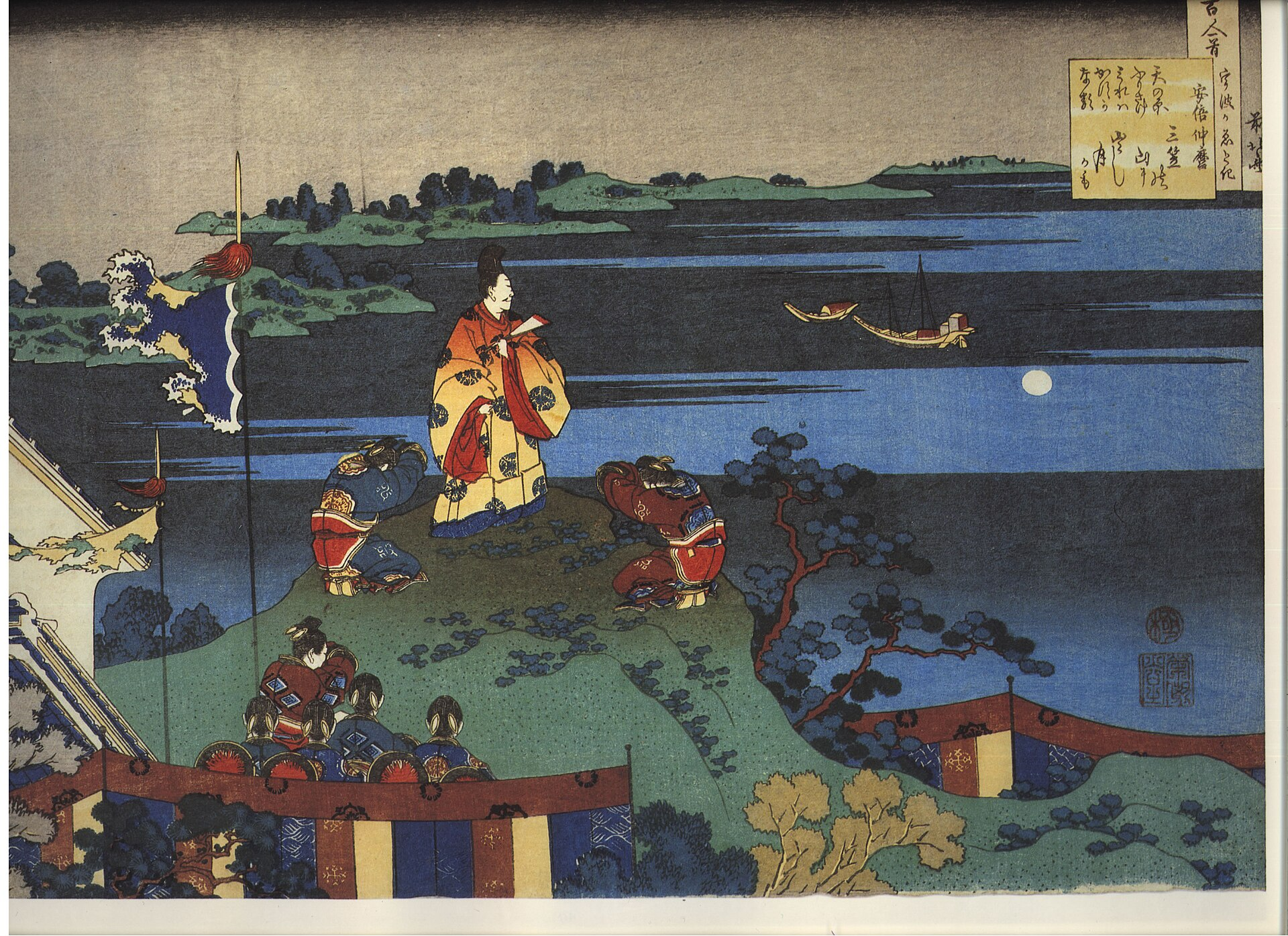
Katsushika Hokusai, Poem by Abe no Nakamaro, from the series One Hundred Poems Explained by the Nurse (Hyakunin isshu uba ga etoki), 1760-1849, Woodblock print; ink and color on paper, 10 3/8 x 14 7/8 in. (26.4 x 37.8 cm), The Metropolitan Museum of Art, New York.
Introduction
The Edo (1603-1868 AD) scholar Motoori Norinaga (1730-1801 AD) wrote in his seminal life work Kojiki-den, published between 1790 and 1798 AD, that the culture and language inherited from the Chinese was inherently anti-Japanese, or in his own words, that “The practice in this world of taking China as the primary model in all things to determine what is good and what is bad is very foolish indeed.”[1] However, the Japanese state of the late Asuka (538-710 AD) and Nara (710-794 AD) periods heavily used China as a means to its own, even while they produced the literature that Motoori based his theories on. The Japanese language borrows heavily from Chinese, which was the de facto lingua franca of the time and which determined the power dynamics of the next several centuries in the larger East Asian context. In looking at the utilization of both Chinese and Japanese state historical narratives, legal frameworks, and Confucian policies, I will contend that the formation of the Japanese state was heavily influenced by the Chinese language as a means to justify kingship to domestic and foreign audiences alike. While this process was not uniform over time and space, nor was the development of the Japanese state borrowed wholesale from China, the influence of the Chinese language itself on Japanese kingship was undeniably influential. This paper will attempt to explore the intricacies of Sino-Japanese relations in its usage of language as a medium to perpetuate change, yet adjusting its implementation in material and scope, to construct the foundations of the imperial Japanese court.
The Japanese Language
The Japanese language as we know it today, and its alphabets Hiragana, Katakana, and Kanji, are distinctly different from their other East Asian linguistic counterparts in the Korean hangul and even Chinese hanzi usage patterns.[2] Japanese and Chinese are fundamentally different languages both in their written and oral forms, and are at most distantly related. The difference in language, which resulted in an imperfect adoption of the characters themselves, nonetheless did not change the fact that Chinese was modeled in both Japan and Korea.[3] From early on in Chinese history, the influence of Chinese characters into the writing systems of the traditional ruling classes of what are today Japan and Korea are undeniable, with both nations having developed some form of writing based upon borrowed Chinese characters, whether with the meaning imported from Chinese or merely the sound of the characters being imported from Chinese. Linguist Bjarke Frellesvig records that the earliest evidence of Chinese characters alone on Japanese soil, dating back to the beginning of the first millennia, may have been merely simple imitations of the materials found on the main continent itself.[4] Even the story of the beginning of writing according to traditional Japanese sources, an invention of the scribes Wani and Akichi in the 5th century AD, saw “writing remain[ing] in the hands of professional scribes (fubito) who were of continental heritage.”[5] In this instance, we can see a close ascription of Chinese writing with the accumulation of power — only the Japanese elite could write Chinese and could afford to have imported materials with Chinese characters. Chinese coins found in Japanese excavation sites may have been accepted as means of payment, thus holding enough value to be recognized as a means of an exchange of goods and services.[6] Thus, as the development of the Japanese state developed and bureaucratic measures were imposed to accord the daily rituals of both the government and the governed, written Chinese became the lingua franca through which matters of state, philosophical teachings, and religious orthodoxy was accorded. Knowledge of written Chinese, and by extension a knowledge of traditional Chinese histories, narratives, and belief systems, were transported from the Chinese monarchies to the elite classes of the early Nara (c. 710-794 AD) and later Heian (c. 794-1185 AD) governments, further trickling into the rank and file of everyday people.
While the existence of the Chinese language in Japan certainly played a significant role in the development of the imperial Japanese state, it also influenced the creation of literature modeled after the Chinese example, in turn leading to the development of a uniquely Japanese script. This is evidenced in the composition and compilation of Chinese poetry. Either in translation from earlier sources or directly composed by the aristocratic class, poetry influenced by the Chinese was highly regarded, just as was the reading and interpretation of Chinese canonical texts in government and Buddhist circles. For example, the Man'yōshū poetry anthology of the Nara period serves as an early example of Chinese characters being used both logographically and phonograpically; in other words, Chinese characters were used both to convey meaning, as was with the case of most Japanese state histories, or to convey the Japano-Chinese reading of the character, forming the basis of a script known as man'yōgana.[7] The script itself, named after the influential anthology in which it is used, is distinguished between ongana (phonograms based on Chinese readings) and kungana (based on Old Japanese reading).[8] While it is not the sole script used in the Man'yōshū, its presence reveals a strong emphasis on the usage of Chinese characters in something as influential as this state-ordained anthology. The work remains useful in understanding the emergence of other kana scripts, themselves flourishing into what we know today as the modern Japanese writing systems. This script (Fig. 2) emphasizes the importance that Chinese characters had over the formation of a Japanese script: Chinese was still seen as a lingua franca for the elite of the East Asian world, but the emergence of a script that represented the uniquely Japanese sounds and grammar of the local ruling class at the time shows a greater willingness to perhaps establish a uniquely Japanese identity within the Sinosphere, even if the script was portrayed through Chinese characters. Poetry was highly influential among the ruling elite, and man'yōgana can perhaps also be interpreted as a utilization of the Chinese script to record a uniquely Japanese form of poetry, itself informing a Japanese literary culture that continued far beyond the Man'yōshū and the emergence of the kana scripts themselves.[9]
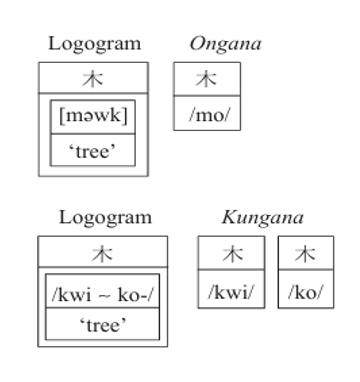
Fig. 1. Diagram of the difference in pronunciation between ongana and kungana. The Old Japanese word for “tree” had the variants “/ko/” and “/kwi/”, whereas the ongana “/mo/” was borrowed from the phonetic manifestation of the Chinese pronunciation of the word, similar to the Old Japanese syllable “/mo/”. Adapted from Frellesvig, History, 15.
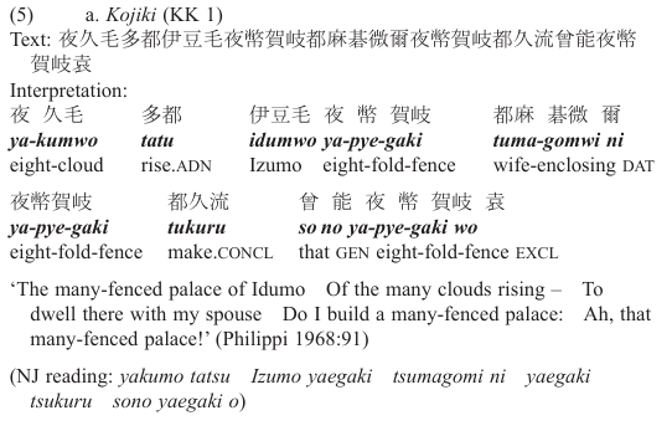
Fig. 2. Diagram of the man'yōgana script in the Kojiki (written 712 AD). The characters here are based off of the reconstructed Old Japanese pronunciation (with New Japanese reading provided below), and would otherwise be gibberish in classical Chinese. Adapted from Frellesvig, History, 19.
The Sinification of writing in Japanese continues to get much more complex and developed over the centuries beyond the Nara period, and is outside the scope of this research project. While the examples above manage to reflect the claim that the Sinification of Japanese had a contribution to the process of state-building, the usage of characters across different geographical regions, chronological timeframes, textual evidence, and linguistic boundaries covers a wide range of influences upon the modern alphabets of Japanese, and was likely not a singular transition process.[10] For example, the transmission of scholars and envoys to the Tang Chinese capital of Chang’an led to a split between old and new ways of reading and pronouncing Japanese, as exemplified in Emperor Kanmu’s (r. 781-806 AD) decrees that “proper Chinese pronunciation”[11] be used in the reading and interpretation of classical Chinese texts, and thus be the language used for the administration of the Chinese civil service exams and in the official recitation of Buddhist sutras.[12] As different pronunciations of Chinese were adopted in Japan in accordance with popular usages in China that differed across time and space, the attentiveness at which this decree was promoted highlights the relevance of the Chinese script to Japanese systems of power. Emperor Kanmu’s decrees (issued c. 792-806 AD), therefore, reflect a growing concern for the government to standardize the Chinese used for Japanese scholars.[13] Not only were scholars studying the Confucian classics in Japanese and serving in the Nara government, using Chinese philosophies of state formation towards their own state, but also mandating the use of the most contemporary version of Chinese towards such studies, emphasizing the importance of the language in Japanese state formation and centralization. The development of Chinese as a writing system in Japan greatly influenced the formation of the Japanese language. We can see the influence of the Chinese political system emerge during the establishment and construction of the Japanese state. As the bureaucracy continued to learn how to rule the people, it borrowed increasingly heavily from Chinese. Following the tract of Chinese characters in a wide range of fields shows a broader picture of the extent to which such authority was justified.
Political Justifications
In order to more closely understand how the Chinese language affected Japanese kingship, it is important to acknowledge the beginnings of the administrative structure that began developing in the islands from the Yamato period (c. 250-710 AD). Japanese kingship first dawned through the development of ritualistic conventions that projected a uniquely Japanese identity amid the emerging political structure and codified legal frameworks of a vastly bureaucratizing state. Historian Joan R. Piggott ascribes the justification of Japanese kingship in the early Yamato periods to official recognition from the Chinese monarchy. This catalyzed the rise of both a “Great King with increased charisma” and a “supraregional confederation under [the] Yamato King;” Piggott further claims that “as far back as the fifth century insular elites began assimilating the sinic concept of the royal realm as ‘all under heaven’, tenka.”[14] As the relationship between the Chinese monarchy continued with the Wa people throughout the Sinosphere, Japan developed a system of hierarchy based on a defined need for structure over strained agricultural resources and competition over trade routes, using both official monastic recognition and cultural influence from the Chinese to consolidate rule.[15] As a result, “within Wa itself the patron-client relationship between Chinese emperor and tributary paramount was replicated by relations between paramount and subordinate chieftains.”[16] By the sixth century, during the Asuka period, an increased need for the supraregional confederation to pool resources and forestall Chinese and Sillan invasions galvanized the formation of the state under the tenno, or heavenly sovereign. While the Chinese-dominated sphere of influence over much of East Asia during this period did influence the formation of the state and the royal throne, the model of rule did not perfectly imitate the Chinese one wholesale. Instead, early statesmen opted to codify existing relationships within Japan while ruling in a Chinese-style bureaucratic state.[17] The policies of the state did model Chinese ones, but it helped Japan come into its own as an independent realm detached from political reliance on — but not influence from — the Chinese monarchy. The tenno could rule Japan as the foremost leader of all of Japan, as it had tributaries which allow it to form the early beginnings of the Japanese model of kingship.
The time of the late Asuka and Nara periods brought a greater bureaucratization to the early Japanese model of kingship. Under Emperor Tenmu and Empress Jito (r. 673-686 AD), the Japanese state underwent a period of great self-consciousness, transforming local kingship into an increasingly complex administrative engine that borrowed heavily from the Chinese. Just as the many Chinese dynasties before it, Tenmu and Jito similarly strove to develop new symbols that manifested their charter for universal sovereignty to be performed in the capital and beyond. They established new offerings and rewards, bestowed promotions and titles, threw banquets of music, song, dance, and Chinese-inspired poetry, and proclaimed providential omens, all designed to glorify the civilizing influence of the virtuous and benevolent emperors.[18]
In such an attempt to assert influence on their empire, Tenmu and Jito used names and identities to centralize imperial power, including a new name for Wa.[19] With this pronounced increased familiarity with Chinese characters, literature, and elitist customs resulting from continued trade with the continent, the Japanese used Chinese to create their own vision for a claim of “all under heaven”. For example, the term tenno (天皇; “heavenly sovereign”) was adopted for popular use around this time. Emperor Gaozong of Tang and his empress also used the terminology at the time. Piggott argues that Yamato rulers borrowed this to both exemplify their claim of omnipotent power over the local population and to demonstrate to foreign courts that the state of Japan also could act as their own polity on equal standing rather than as a territorial or vassal state.[20]
Even the name of Japan today, Nihon, first appears textually in 707 AD, with evidence of increased usage during the reigns of Tenmu and Jito.[21] Meaning “source of the sun”, the phrase likely had already been in use as a poetic referent for the much older term “Yamato,” with a Chinese anecdote even suggesting that the term came from Empress Wu Zetian (r. 684-705) herself.[22] The implementation of Nihon bolstered Temmu’s royal charter and ancestral claim to the gods via Emperor Jimmu. As Piggott writes, “of the various poetic ways to refer to Yamato, Nihon was the only one that was logographic rather than phonetic and whose meaning was instantly recognizable wherever Chinese characters were in use.”[23] This proved immense—the Japanese adoption of this term lent greater credence around a strong and centralized kingship recognizable both abroad and domestically, changing “the whole history of Chinese-Japanese diplomatic relations since the turn of the seventh century.”[24] Through the use of new naming rituals adopted during the reigns of Tenmu and Jito, the identity of the Nara regime morphed around a concurrent political and cultural bureaucratization of the state. Tenmu and Jito implemented new rituals with the intention to “demonstrate authority, confirm the prestige hierarchy of the realm, and evidence heaven’s support,” adopting terms such as tenno and Nihon to push for concentrated power that acted as latching points for regional chieftains to associate themselves with the court and to prove to other foreign powers that the Japanese could just as well rule as omnipotent sovereigns.[25] As the supraregional confederation of kings began to morph into the powerhouse of Japanese society cemented in the late Asuka and Nara periods, the influence of Chinese characters, through various law codes and historical narratives, continued to play a central role in how Japanese rulers consolidated their rule, as laid out below.
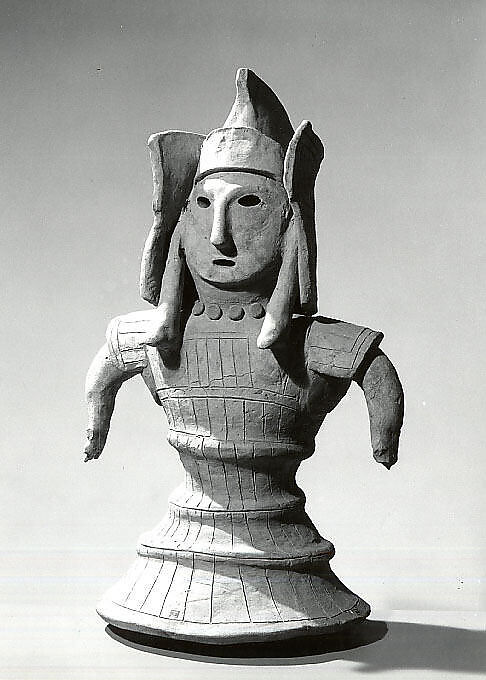
Haniwa Figure of a Warrior. Kofun Period (c. 300-710 CE). Earthenware with painted, incised, and applied decoration, 22 7/8 in. Sourced from the Metropolitan Museum of Art, The Michael C. Rockefeller Memorial Collection, Gift of Mrs. John D. Rockefeller III, 1958. https://www.metmuseum.org/art/collection/search/45545.
Constructing Historical Narratives
The construction of historical narratives comprised one primary medium through which facts and events recorded. But they also pushed narratives concerning Japanese kingship. The Rikkokushi, or six imperial histories, chronicles the history of the court from the origins of Japanese mythology to the mid-Heian period and was composed by the order of the emperor. These six narratives thus embody the official history of the state. Political underlining throughout these histories in comparison to the Chinese histories that served as their precedent provides a greater glimpse into how the Chinese language influenced the politics of Japan.
Firstly, this paper will compare several selections of the Nihon Shoki to the work of the Shiji, China’s first major history, compiled by grand historian Sima Qian during the Han dynasty (206 BC - 220 AD).[26] The Nihon Shoki is Japan’s oldest classical historical record and one of the six imperial histories of the period, and universally depicts the history of Japan from its founding into its present day, albeit not in the format of an historical narrative as we understand it today. It was first compiled and presented to the court of Empress Gensho in 720 under the editorial supervision of court bureaucrat and chronicler O no Yasumaro with a clear-cut “effort to position Japan at its rightful place among the three cultures of East Asia [Tang China, Nara Japan, Silla Korea].”[27] Within these selections, the Nihon Shoki attempts to paint a Japan that could rival China, and as such, places a heavy focus on constructing its own mythological origins in a similar manner to that of the Chinese origin stories recorded in the Shiji. For instance, the narrative of the legendary first Japanese emperor, Jinmu, shows a clear structural similarity to the record of Huangdi (the legendary Yellow Emperor) in the Shiji. The Shiji records that
“Huangdi (Yellow emperor) was the son of Shaodian. His surname was Gongsun, and his prename Xuanyuan. Born a genius he could speak when a baby, as a boy he was quick and smart, as a youth simple and earnest, and when grown up intelligent.”[28]
黃帝者,少典之子,姓公孫,名曰軒轅。生而神靈,弱而能言,幼而徇齊,長而敦敏,成而聰明。
Similarly, the Nihon Shoki writes that,
“Kamu Yamato Iwarebiko no Sumera Mikoto [Jinmu Tennō], named Hikohohodemi, was the fourth son of Hikonagisatake Ugayafuki Aezu no Mikoto…The Emperor was wise from birth, and was resolute in character.”[29]
神日本磐余彥天皇、諱彥火々出見、彥波瀲武鸕鷀草葺不合尊第四子也、母曰玉依姬、海童之少女也。天皇生而明達、意礭如也。
Both narratives highlight these founding characters as divinely chosen and righteous from birth, carrying the moral ability to lead their people and therefore form the basis of the beginnings of their respective empires. The Japanese ruling family drew their lineage from Emperor Jinmu and beyond that to the deities and spirits described in the beginning of the Nihon Shoki. Thus, they could draw a very linear path from those in power at the time, justifying their rule over the literate aristocracy and the common people, and furthermore “appealed internationally to the status of the state being an independent entity of its neighbors, and therefore entitled to equal treatment.”[30]
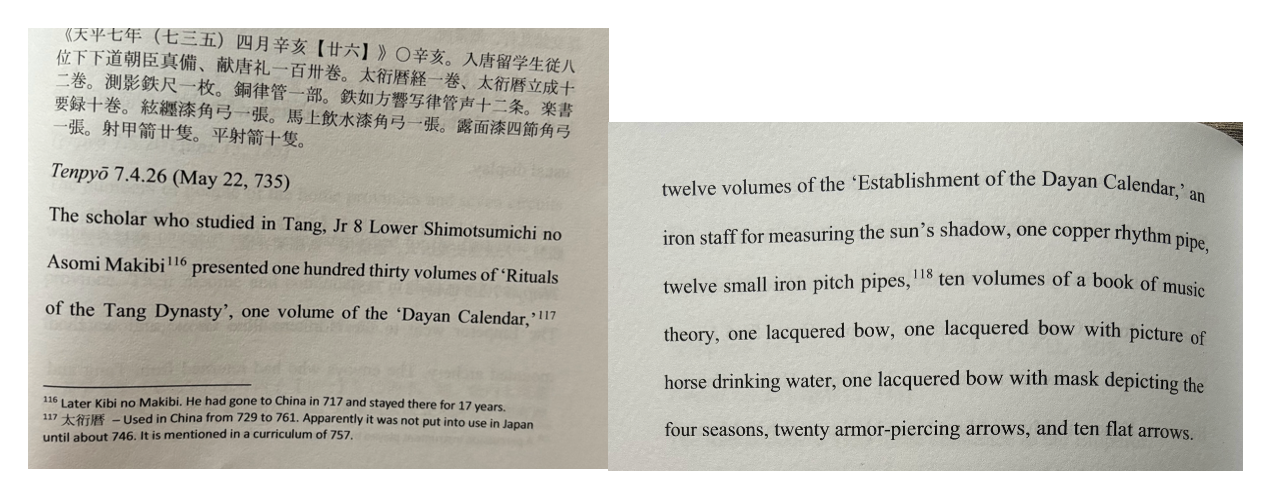
Figures 3 (left) and 4 (right). Entry from the Shoku Nihongi, depicting the court proceedings of a scholar who studied in the Tang, upon his return to Japan. Adapted from Bender, Emperor Shomu, 285-286. Photograph taken by the author.
There are also discernible similarities between the wording of the texts themselves. A turn to the Shoku Nihongi (c. 797 AD), a successor to the Nihon Shoki and the second of the six imperial histories, can also present a more grounded clue as to how the historical framework of events were laid out. Figures 5, 6, and 7 show two entries, one from the Shoku Nihongi and another from the San Guo Zhi.[31] In these texts, the first clear distinction is the dating structure. Both historical narratives begin with the era name of the reigning monarch, the year of said monarch that this entry was recorded in, and the month and day of the event as per the sexagenary cycle of dating used during this period.
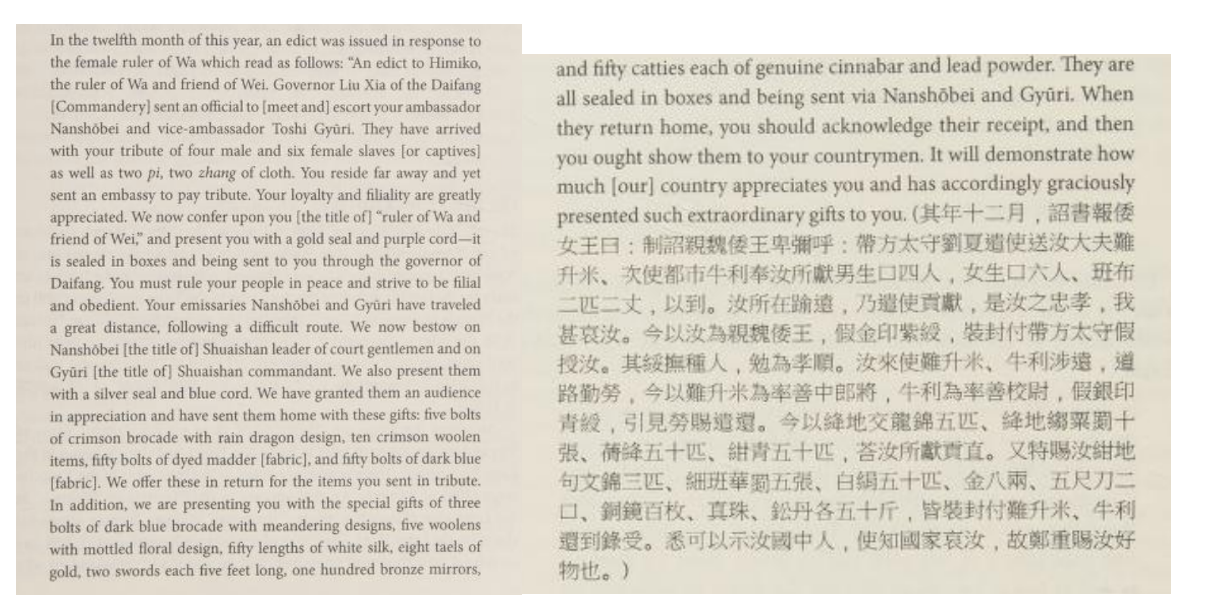
Figures 3 (left) and 4 (right). Entry from the San Guo Zhi, depicting a decree enumerating the tributes received and the gifts and titles bestowed to Wa in reciprocation. Adapted from Saeki and Fogel, Treatise on the People of Wa, 269-270.
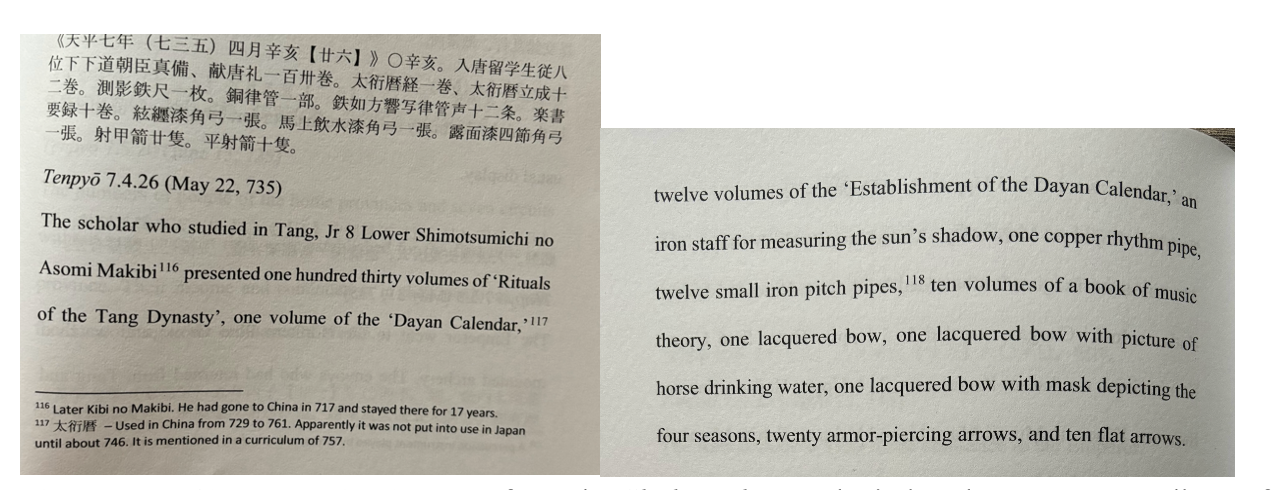
Figures 5 (left) and 6 (right). Entry from the Shoku Nihongi, depicting the court proceedings of a scholar who studied in the Tang, upon his return to Japan. Adapted from Bender, Emperor Shomu, 285-286. Photograph taken by the author.
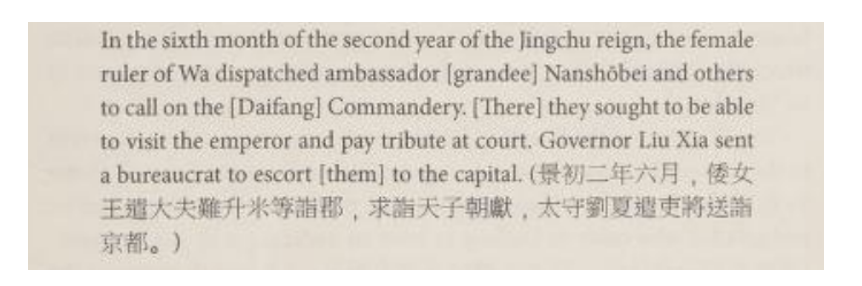
Figure 7. Entry from the San Guo Zhi, depicting foreign relations between the Wa state under Empress Himiko (r. 180-247/248 AD). Adapted from Saeki and Fogel, Treatise on the People of Wa, 263.
All inscriptions covering the reign of Emperor Shomu in the Shoku Nihongi are recorded in such a manner and deliberately appear to copy the Chinese tradition established in part by the San Guo Zhi centuries prior. Secondly, both Figures 3 and 4 and Figures 5 and 6 discuss the transfer of goods accorded through diplomatic missions between the Wa kingdom and the Wei state and the Nara and Tang states. In both accounts, the number of materials is listed in a straightforward manner, and there is an exact record of how much of a particular item was brought forward and by whom. This perhaps suggests that the Chinese and Japanese both saw the creation of official histories as not a space to tell stories and recount the livelihoods of people, but to record facts and figures to both paint a picture of life within their times and paint a narrative that they can push with an official history. For example, Figure 7 depicts a governor, Liu Xia, “conferring” upon the Wa monarch titles and gifts as a reward for “your loyalty and filiality,” suggesting in the end that such a gift “demonstrate[s] how much [our] country appreciates you and has accordingly graciously presented such extraordinary gifts to you.”[32] Here, history is power: the San Guo Zhi merely describes an imperial edict, but the deliberate inclusion of Liu Xia’s words (which themselves may not even be accurate, as dialogue and speech are often fabricated) suggests a view of the Wei state as inherently superior to the Wa, who must dutifully pay tribute. In looking at Figures 5 and 6, however, the Nara state does not view the Tang in this light and does not comment on anything other than the fact that the scholar presented his accorded items to the court. The inscription instead paints a scene of regal acknowledgment: former and subsequent trips to the Tang capital were widely encouraged and even funded by the Nara state, and it is safe to assume that the scholar’s trip to Tang China, especially if it warranted an inclusion in the official state history, received handsome rewards as well.[33]
These narratives were all written in standard classical Chinese with slight exhibitions of Japanese influence. They remain understandable in classical Chinese and do not require for the reader to have an understanding of either classical Japanese or the man'yōgana script that it is based upon.[34] The creation of the Nihon Shoki, and its focus on presenting the work in Chinese, is important because of its clear implication of a tie to the more elite culture of China that was fully embraced by the court of the late-Asuka and Nara periods. O no Yasumaro, and to a larger extent the entire Japanese imperial court of the time, wrote to both their domestic audience of the aristocracy and to foreign embassies to legitimize their rule over the state. The establishment of a new capital at Heijo-kyo (modern day Nara) acted as another legitimate reason to create the Nihon Shoki, thereby branding their rule as determined by divine descent, centralizing the bureaucracy, and depicting the leaders of Japan as eternal and rightfully instituted. In turn, by tying their government to the Chinese histories, the administration became more noble in culture and thus more palatable to those in the Sinosphere. In analyzing the historical narratives of the Shoku Nihongi and the San Guo Zhi, it is clear that there were obvious similarities between the way that history was recorded and treated several centuries apart in China and Japan, with the histories of the Nara court being closely modeled to that of the Shiji and the San Guo Zhi. The construction of historical narratives served to both codify current events and legitimize the fledgling Nara state as one that was on equal footing with the Tang, having a strong and shared sense of belonging and identity, and using this envisioned past to speak lengths about the position of the state’s current position and future affairs.
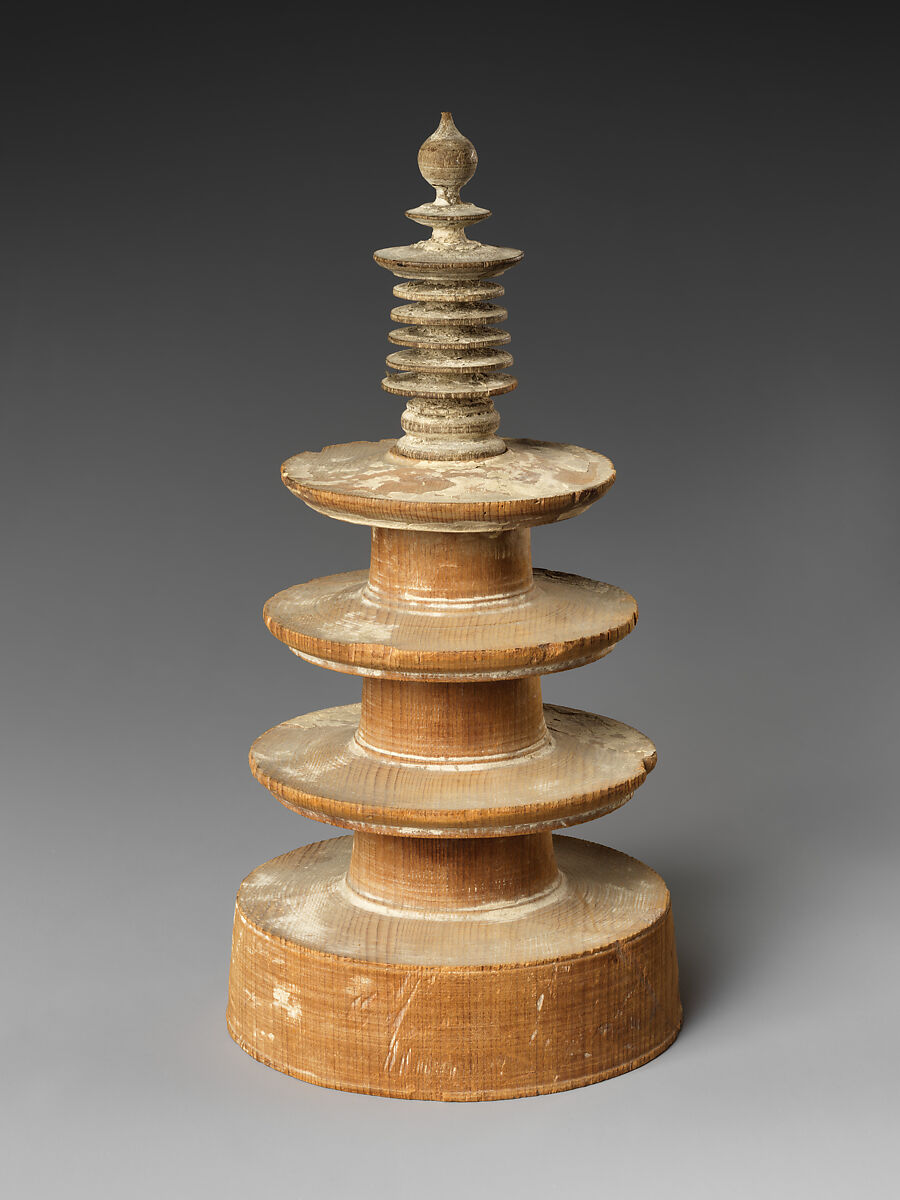
One of the “One Million Pagodas” (Hyakumanto) and Invocation. Nara Period (c. 710-794 CE). Japanese cypress (hinoki) sculpture, 8 3/8 in. Sourced from the Metropolitan Museum of Art, Gift of Benjamin Strong, 1930. https://www.metmuseum.org/art/collection/search/44955.
Legal Frameworks and Confucianism
Another method through which the role of Chinese characters and language can be seen influencing the Japanese model of kingship is through the extensive legal frameworks that sprouted as a result of an expanding bureaucracy. The Japanese formed the ritsuryō state (律令國家) out of a need for a “decisive commitment to certain reform policies,” leading to the “blending of Chinese-style penal (ritsu) and administrative (ryō) codes that defined its structure and operation.”[35]
In 689 AD, the aforementioned rulers Tenmu and Jito (r. 673-686 AD) implemented the Kiyomihara (飛鳥浄御原令) law code, the first historically verifiable ritsuryō code in Japanese history, as a means to “confirm policies and structures [designed to]...incorporate local elites throughout the realm into Tenmu’s expanded court society.”[36] Prior to and throughout this period, the establishment of kabane (姓) titles (accrued on a hereditary basis) and kan’i (冠位) titles (awarded for one’s lifetime) was the primary method in which status was decided, with the latter representing the bureaucratic principles of a slowly forming meritocracy within the Japanese state.[37] The ritsuryo government at its peak featured two main engines through which the state functioned, the Council of Religious Affairs (jingikan 神祇官) and the Great Council of State (daijokan 太政官). Under the latter, the administration was split into a Chancellor (daijo daijin 太政大臣), two Ministers (sadaijin 左大臣 and udaijin 右大臣), and a number of lower officials and counselors split between eight ministries.[38] This was similar in appearance to the Chinese system of government, consisting of three departments and six ministries.[39] Despite administrative discrepancies, the close modeling of the Japanese and Chinese bureaucracies shows the immense influence of the latter to the former, notably in the naming of the institutions themselves.[40]
By the same token, one of Tenmu’s largest contributions to the Japanese legal corpus was the elaboration of the Justice Ministry which allowed him to create a bureaucratic office that controlled the deployment of punishments on a scale previously unprecedented.[41] The laws themselves were also highly inspired by the existing Tang law code, written in 624 AD and promulgated in 653 AD under Emperor Gaozong of Tang (r. 649-683). A royal edict in 682 AD showcases the extent of criminal justice and the newfound power of the Justice Ministry to maintain order on behalf of the king (Figure 8). Here, we can see that crimes were treated matter of fact, without concealment, regardless of the location of the crime. The slight caveat that “grave crimes” were left to the hands of the crown, however, could suggest a slight preferential treatment in crimes committed by elites and crimes committed by a non-elite or lower elite. Such attitudes are also visible in Chinese criminal law. The Tang law code theoretically held that “throughout the empire a particular crime would be met with precisely the same punishment”, but at the same time “much of the section of the code on General Principles is devoted to guaranteeing some classes of persons a reduction of punishment for certain types of offenses, and/or the right to pay a fine instead.”[42] Evidently, both Tenmu’s edict and the Tang law code solidify the role of the emperor as the rightful link between heaven and the earth, and the center of administration. The centralized and bureaucratic machine emphasized here by the Asuka/Nara emperors and their Tang counterparts in their respective empires highlights a push to extend and protect monarchical power throughout their territories. Tenmu’s claim as the rightful and virtuous ruler of all under heaven is further stressed by his inclusion of “royal princes, royal relatives, ministers, and commoners.” By including every being under the sun as belonging under his jurisdiction, his position as emperor became transcendent, omnipotent, omnipresent, and above all, fair. Thus, the kingship of the Japanese state took on a form that was a far cry from the supraregional confederation of the Yamato period, with the ideal of a sovereign no longer a local problem-solver but rather the primary benefactor and guardian of a kingdom.
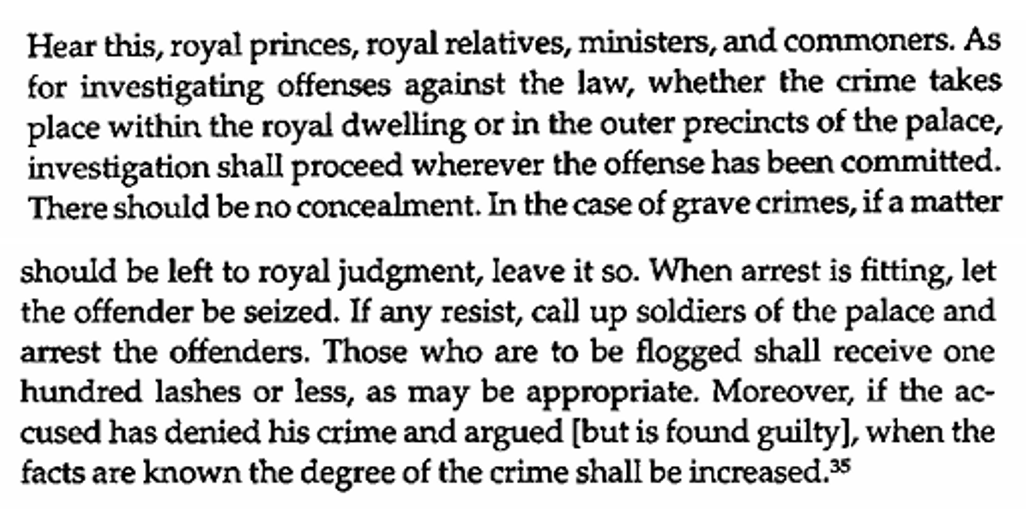
Figure 8. Imperial Edict of Emperor Tenmu, 682 AD. Translated by Joan Piggott. Adapted from Piggott, Emergence, 137-138. Originally sourced from Nihon Shoki, 682 AD, 11/16.
Over the course of the Nara period, various law codes modeled after the Tang law code helped to maintain extant Japanese intergovernmental relations and shape it into the Council of State and Eight Ministries, as established by the Taiho 大寳律令 and Yoro 養老律令 codes (701 AD).[43] Outside of the formation of the aforementioned offices and promotion of individuals to fill those offices, as well as the formation of provinces and districts, these two codes also helped to expand Confucian influence across the Nara state. While China underwent its own centralization of state power in 700 BC, Confucius and other notable scholars became foremost Confucian sages in Tang ritual by the time of the Nara.[44] Professor and historian Charles Holcombe adds that “biannual sacrifices to Confucius began in 701 [in Japan]” as mandated by the Taiho and Yoro codes. Additionally, “when it was learned that the T’ang Chinese had previously enfeoffed Confucius as Prince Propagating Culture in 739, the Japanese court duplicated the move in 768.”[45] This centralizing move by the Codes not only cemented Confucius, a Chinese scholar long dead for over a thousand years, as a key figure in government-sponsored Confucian circles, but also utilized a Chinese title to do so, showing the core value of Chinese characters in Japan’s centering of Confucianism.
Understanding these core Confucian influences paints a picture of Japan as closely modeling the Chinese form of government. In fact, much of the Nara court utilized Confucian scholars: Fujiwara no Muchimaro, assistant at the university and tutor to the Crown Prince, “lamented that ‘the age did not favor scholarship,’ and promoted a revitalization of the curriculum.”[46] After his implementation of Confucian values into the education of the Court, “‘The Crown Prince thereupon gave up his prowls in the fields and finally took an interest in the perfection of literary teachings. Therefore, after he ascended the throne, he always practiced good government, had sympathy for the common people, and esteemed the Buddhist dharma.’”[47] Muchimaro, alongside scholars such as Abe no Nakamaro, contributed a hand in forming the Nara state and thus helping Confucian-ize the state early on, albeit it being a very gradual process with generations of scholars and sponsoring emperors involved. Muchimaro’s own narrative here, even if it is true that he was such a dutiful devotee of Confucianism, seems more to suggest an air of “conscious family self-glorification,” positioning a portrait of the Fujiwara family as embracing Chinese-style administration and cultural hegemony.[48] More importantly, Muchimaro’s contributions in regal education highlight the value placed by the Japanese court towards Confucian orthodoxy as a model towards their government, and towards Chinese characters as a lens to exercise such orthodoxy. Future edicts determined by the Confucian-educated aristocracy were all written in Chinese characters, and thus the creation of laws were not only influenced by the fundamentals of Chinese law but also the characters themselves. Writing legal codes in Chinese cemented a connection between the language and power. Therefore, the ideal of Confucian government and education played a significant role in the construction of legal frameworks in Nara Japan, which in itself promoted the expanded importance of Chinese characters in planting a process of general sinification by the early- to mid-eighth century.
We can ascertain further Confucian influences from analyzing the Tang law code and the similarities presented within the senmyo, imperial edicts recorded in Old Japanese.[49] These edicts had their root in Chinese-influenced imperial commands (Chinese zhaoling 詔令), which by the Tang Dynasty was being written by officials with high literary ability, itself indicative of “politically powerful offices [providing] proximity to the sovereign.”[50] The senmyo themselves contained many tropes also visible in similar Chinese zhaoling, including a Crown Prince’s reluctance to take the throne (the “three refusals”), proclamations of amnesty, and reverence towards the names of the emperors themselves.[51] This is seen in Figure 9, where the Emperor Monmu proclaims himself as the “Manifest God” that rules over the “High Throne of Heavenly Sun Succession” in the “Great Land of Many Islands.”[52] Similarly, in the Tang Law Code, the Emperor is proclaimed to have “wide and great mercy” and “showers the spring clouds of his kindness upon all assorted creatures.”[53] In both instances, Confucian implements of virtue and righteousness extend even to the titles and descriptions of the rulers. The idea that “virtue and ritual are the basis of governmental teaching; punishment and chastisements are the instruments of governmental teaching” is encoded through the name of the tenno.[54] Regardless of gender, this positions the rulers as the paramount exemplars of Confucian ideals and thus the most fit to rule all of the kingdom. The Japanese thus took Confucian convictions such as filiality and benevolence to the people as a basis upon which they could elevate myth and magic, connecting their omnipotent rule to the omnipresent power of the gods. This Confucian rhetoric is also echoed in the later Shoku Nihongi. For example, in Figure 9, the imperial edicts of Emperor Shomu in 726 AD cited the Chinese classics as basis for their actions, and proclaimed the Court as parents of the empire, using Confucian rhetoric to further the notion of the rulers’ duty to its citizens and cementing the image of a Japan influenced by Chinese belief systems. Here, we see the usage of Chinese language to reinforce Chinese-inspired Confucian thought as an impetus for wielding power, with the wording directly styled by the government upon its people. Only later are the edicts of Shomu recorded in the Shoku Nihongi as a written record, purposefully concomitant with an image of virtuous rulers existing well throughout the Nara period and before that.
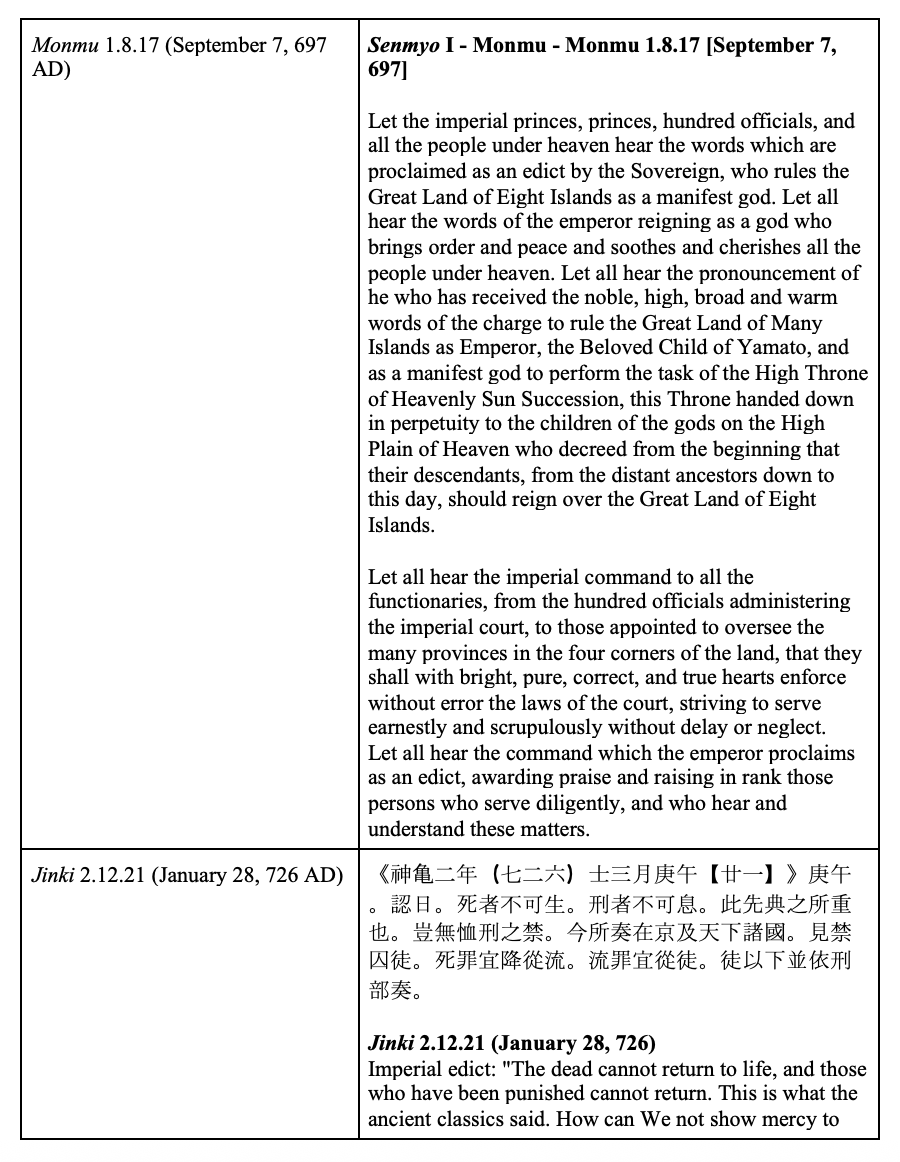
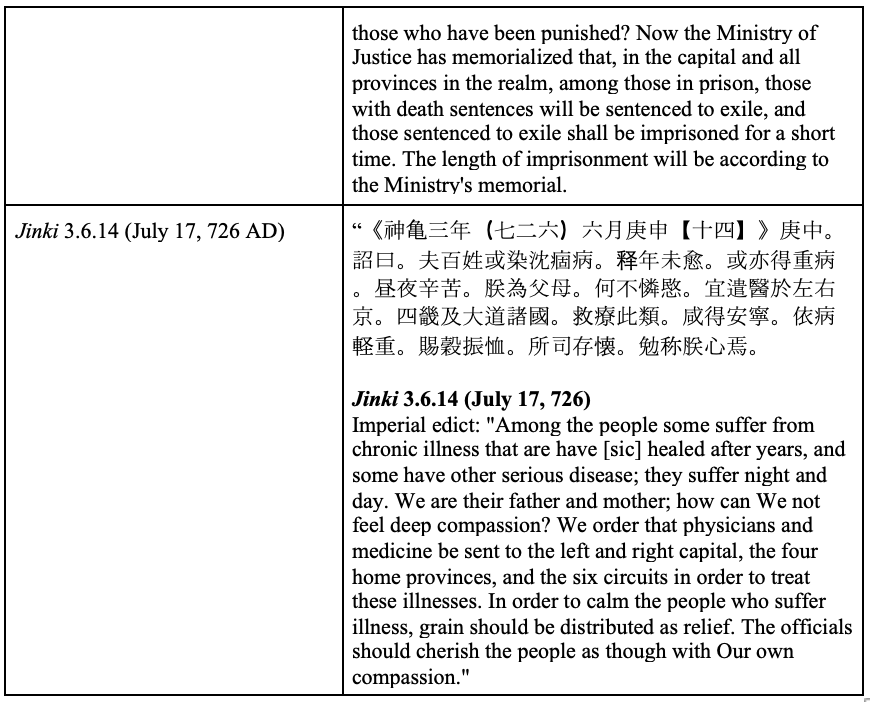
Figure 9. Table depicting Monmu 1.8.17, Jinki 2.12.21 (1/28/726 AD), and Jinki 3.6.14 (7/17/726 AD), all imperial edicts. Adapted from Bender, Senmyo, 32-33; Bender, Emperor Shomu, 97, 103-104.
Additionally, the Taiho and Yoro codes deviated from the Tang orthodoxy in their rejection of the Mandate of Heaven, instead espousing a ruler descended, and thus drawing power from, uniquely Japanese/Shinto gods. The Japanese state, as seen in Figure 9, described themselves as omnipotent beings that represented not solely the Chinese-inspired vision of good government, but also the beliefs of Shinto and other belief systems, creating a ruler distinct from that of the Tang. Thus, the Japanese tenno could both envelop “a balance of imperial virtue, bureaucratic diligence, and divine protection” as accorded by the uniquely Japanese gods and ancestors, delivering a promise to the people of a good harvest, peaceful skies, and favorable weather.[55] This Confucian ideal of government created the beginnings of a bureaucratic system based in a meritocracy and inspired by structures such as the Chinese civil service examination system with the court at the center. The image of the court first had to be upheld as a shining exemplar of Confucian principles. This was extended to the people by way of the legal morality of an appointed meritocracy. The aforementioned Abe no Nakamaro traveled on behalf of the court to China to learn the ways of the Confucian classics, continuing a tradition of Sino-Japanese educational exchange that the Nihon Shoki observes as far back as the mid-Asuka period (Figure 10). Jinki 3.6.14 in Figure 9 builds an image of the tenno as father and mother tasked with the welfare of the people. The Taiho code specifically builds upon this, claiming just a week after the announcement of the code that “all those who practiced filial piety for generations, from great grandparents to great-great grandchildren, would have their tax and labor service obligations remitted for their entire household, and a banner would be displayed over their village to show that there was a virtuous family within.”[56] The image of a filial leader protecting their filial subjects through filial ministers upheld a government modeled closely, yet in its own ways divergent from, the Chinese-style Confucian government. Thus, the Confucian monarch had to both demonstrate their own virtue and propagate such virtue onto their subjects, who were supposed to uphold the integrity of the state through meritocratic action.
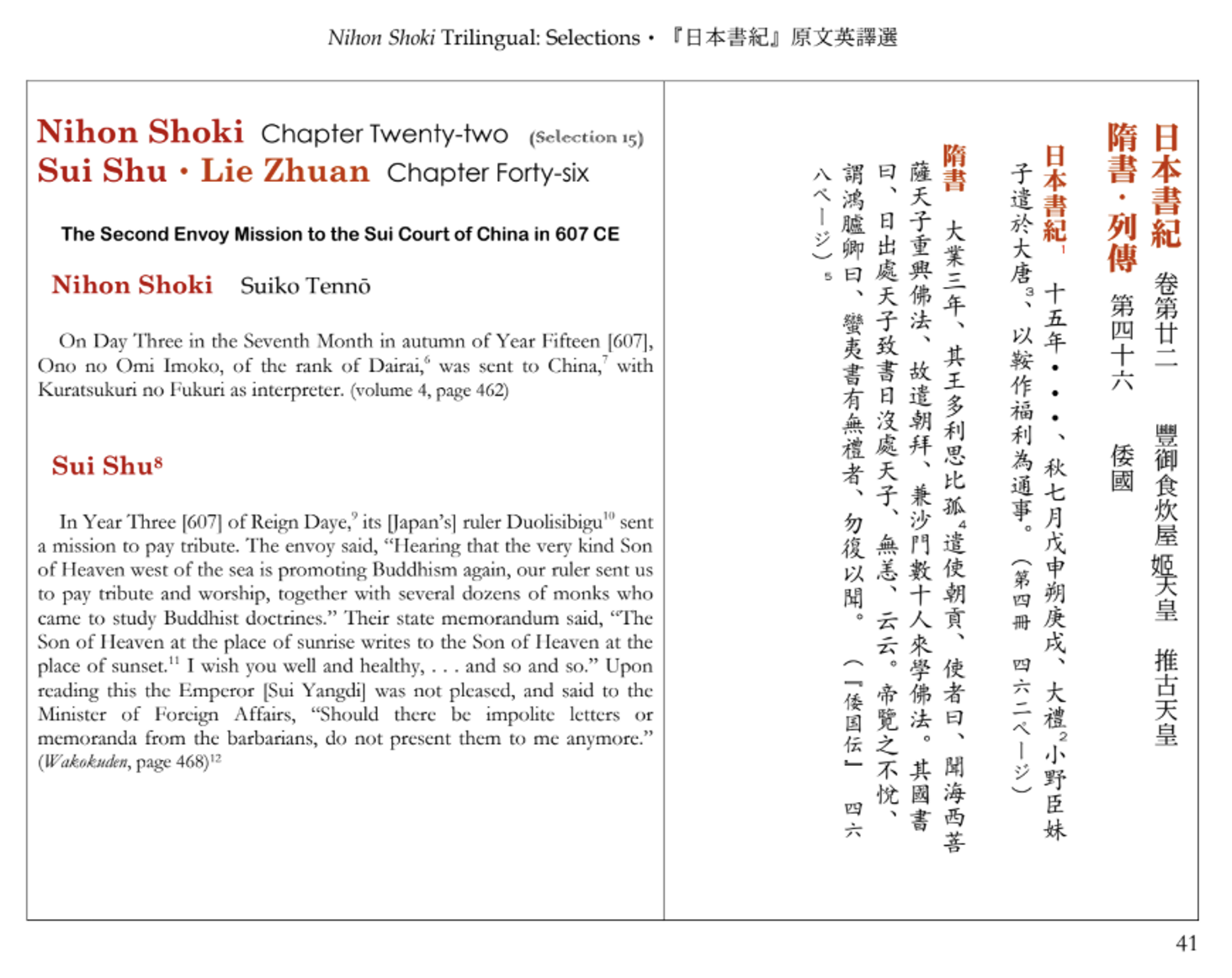
Figure 10. Comparison between the records of an envoy mission between Ono no Omi Imoko of the Asuka and the Tang court in the Nihon Shoki and the Sui Shu (compiled c. 636 AD by Wei Zheng), the court history of the Sui Dynasty (581-636 AD). Note that the Sui Shu adds Sui Yangdi’s disgust over this “memoranda from the barbarians.” Adapted from Chor, “Nihon Shoki,” 41.
However, despite these two codes promoting semblances of a meritocracy, adherence to inherited social statuses rather than a constructed meritocracy did not hold up past the Nara. A lack of meritocratic governance led to the court being populated by members of influential families, most notably the Fujiwara, who have by the 7th century already begun to dominate the imperial court — the compiler of the Omi code was the founder of the Fujiwara clan himself![57] Opportunities for social mobility were also often scant, with most of the aristocratic class retaining their territories and influence and with most scholars sent over to China being within this class themselves. These codes assured the statuses of contemporary elites, who had ranks and titles bestowed upon them individually rather than upon the chiefs of kinship groups, leading to the maintenance of power amongst stem lineages (ie). Thus, for example, “the four sons of Fujiwara Fuhito establish[ed] four separate lineages in the eighth century, and by the late 730s sons of those lineages were rivals for ranks and posts.”[58] The Fujiwara clan became entrenched into imperial Japanese politics well into and lasting beyond the Heian period, being thrown out of favorable government positions in 1868. Control over the government was vested into the hands of several influential families while not being representative of the meritocracy espoused by Confucianism. Such control formed the core of a bureaucratic system that worked well for the aims of the Japanese state. Thus, the Fujiwara adopted the practices of the Chinese as a means to project a certain status and narrative domestically and internationally, and to also adapt this system to fit their unique needs in the enforcement and implementation of laws.
The Chinese language, whether it be through the phonetic mangoyana or in written classical Chinese, remained crucial towards developing the law codes and legal structures of the late Asuka and Nara periods. These were all written in classical Chinese, framed through the discourse of Confucian-inspired scholars, and disseminated across all of Japan to build a Chinese-style imperial bureaucracy, adapted to fit the Japanese model of kingship. A part of constructing the Japanese state included the construction of a belief system made to model the Japanese government and its administrative principles, and the spread of Confucian influence across the foundational law codes of Asuka and Nara history cemented the bureaucratic engine of the state’s justification towards power. The heavy emphasis on education in the Confucian context also meant that the Japanese promoted the scholarship of the Chinese language, not just Confucian beliefs. Historian Alexander N. Mesheryakov proposes that the pure quantity of characters amounted to over eleven million characters painstakingly copied daily by several hundred scribes monthly by the beginning of the eighth century.[59] Information and education, displayed through the Chinese language, concentrated power in the capital and highlighted the importance of the learning and application of the language. What it meant to be a Japanese ruler during the Nara, therefore, was largely (yet not entirely) sculpted from the mold of the Chinese imperial monarchy, and the worship of a Japanese ritsuryo tenno became structured behind its preeminence as “culture hero and civilizer, lawgiver, realm-protector, and Buddhist savior-king.”[60]
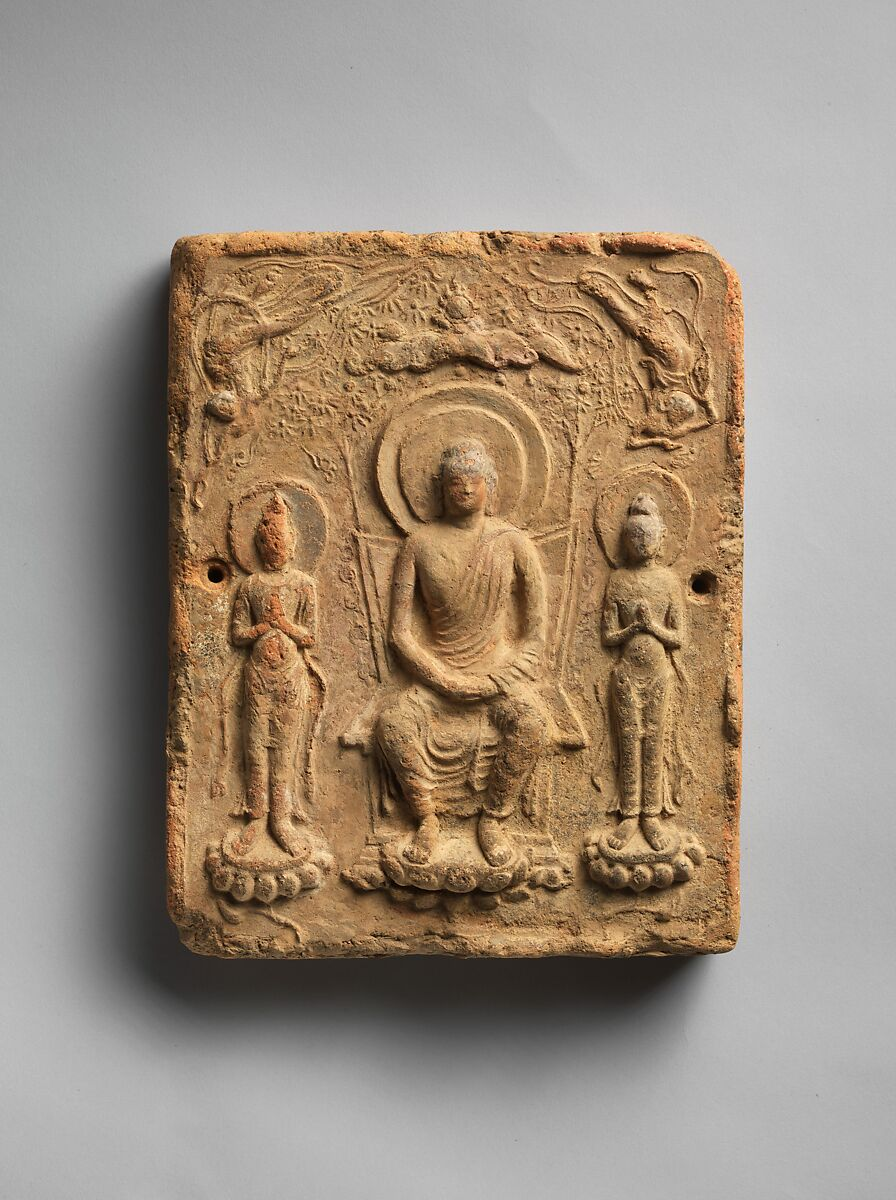
Top: Tile with Buddha Triad. Second half of the 7th century, Asuka Period (538-710), Japan. Earthenware, H. 9 5/8 in. (24.5 cm); W. 7 3/4 in. (19.7 cm); D. 1 1/2 in. (3.8 cm). Sourced from the Metropolitan Museum of Art, Mary Griggs Burke Collection, Gift of the Mary and Jackson Burke Foundation, 2015. https://www.metmuseum.org/art/collection/search/53158.
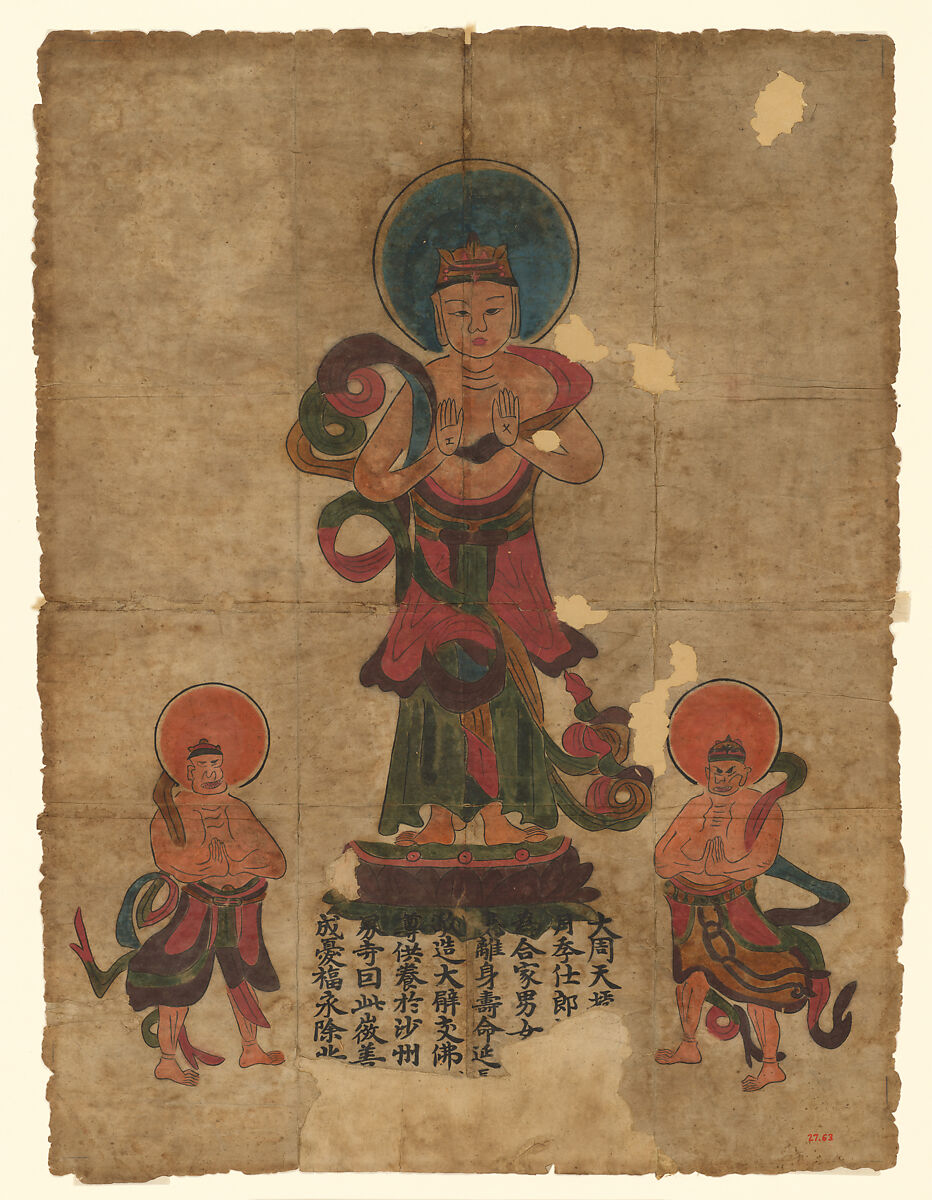
Unidentified artist, The Thousand Buddha Grotto. 690-691, Mogao Caves, Dunhuang, Gansu, China. Sourced from the Metropolitan Museum of Art.
Note that both figures display the Buddha with attendants flanking the main figure, and both could be depicting the same scene of the bodhisattva sitting under the bodhi tree with unnamed attendants. The Japanese tile is believed to have been an interior wall decoration at Tachibanadera Temple in Asuka, near the ancient capital of Nara. The Chinese wall painting is likely to have come from caves that were used for worship and pilgrimage purposes.
Conclusion
The picture of Japanese kingship is in fact drawn extensively from the Chinese language, as can be seen through both Chinese and Japanese historical narratives, legal frameworks, and Confucian policies. In structuring this picture, the Japanese language itself is also largely drawn from Chinese and helped to politically justify the rule of the late Asuka and Nara period kings and queens. These rulers were tied to divine right, whether through their histories or their laws, and provided a fertile ground for the blossoming of a new royal ideology designed to legitimize, stabilize, and bureaucratize their rule. The Chinese-style expansion of a government laid out in a bureaucratic manner, reaching commoners near and far, and expanded the reach of the monarchy across their lands. Chinese as a language influenced the growth of education across the aristocracy, influencing areas as diverse as coinage, architecture, poetry, literature, fashion styles, and religion that warrant further exploration for a fuller picture of the true extent of Sino-Japanese intermixing. While Chinese and China, both in the contemporary day and before it, remained extremely important towards constructing an image of Japan, it was not wholesale. It was not a one-dimensional, succinct, or geographically and chronologically linear transfer of information and influence across ancient borders, as with all history, but a far more complex fabric of a relationship between the two kingdoms. Chinese also represented a status symbol — primarily the aristocracy used the language — so even if the laws promulgated by the Court were written in classical Chinese or man'yōgana, the common people didn’t have the ability, time, nor need to learn and read a language that didn’t truly represent their daily lived experiences. Regardless, it is evident that the influence of China and the language of Chinese itself painted the portrait of Japanese kingship, and the relationship between these two kingdoms continued until the modern day. Regardless of China’s core differences with Japan, to the extent that they were later seen as “barbarian,” the two are intricately linked. Motoori Norinaga’s criticism of a Sinicized Japan that ought not be influenced by “barbarian” culture, therefore, stemmed from the foundational role of China in the emergence of Japanese kingship, breeding both love and disdain (as in Norinaga’s case), even in the Edo period, with the relationship between the two.
Bibliography
Batten, Bruce L. “Foreign Threat and Domestic Reform: The Emergence of the Ritsuryō State.” Monumenta Nipponica 41, no. 2 (Summer, 1986): 199–219. https://www.jstor.org/stable/2384665.
Bender, Ross. Emperor Shomu: Early Years, 724–737. Self-published, 2024.
Bender, Ross. “Senmyō: Old Japanese Imperial Edicts in the National Histories, 697-887.” Self-published, 2021.
Bentley, John. “The Birth and Flowering of Japanese Historiography: From Chronicles to Tales to Historical Interpretation.” in Sarah Foot and Chase F. Robinson (eds.), The Oxford History of Historical Writing: Volume 2: 400-1400 (2012): 58-79. https://doi.org/10.1093/oso/9780199236428.003.0004.
Chor, Louis. Nihon Shoki (日本書紀) Trilingual: Selections in the Original Classical Chinese (Kanbun) with English Translation Based on the Iwanami Bunko Edition (Five Volumes, 1994–1995). Alberta: University of Alberta Press, 2018.
Frellesvig, Bjarke. A History of the Japanese Language. Cambridge: Cambridge University Press, 2010.
Holcombe, Charles. “Ritsuryō Confucianism.” Harvard Journal of Asiatic Studies 57, no. 2 (Dec 1997): 543–573. https://www.jstor.org/stable/2719487.
Johnson, Wallace. The T’ang Code: Volume I, General Principles. Princeton: Princeton University Press, 1979.
Kim, Chŏng-su, Ross King, and Sejong. The History and Future of Hangeul: Korea’s Indigenous Script. Kent, CT: Global Oriental, 2005.
Mesheryakov Alexander N., “On the Quantity of Written Data Produced by the Ritsuryo State.” Japan Review, no. 15 (2003): 187-199. https://www.jstor.org/stable/25791275.
Motoori, Norinaga. Kojiki-den: Book 1. Translated by Ann Wehmeyer. Ithaca: Cornell University Press, 1997.
Pae, Hye K. “Chapter 6: Chinese, Japanese, and Korean Writing Systems: All East-Asian but Different Scripts.” Script Effects as the Hidden Drive of the Mind, Cognition, and Culture. Cham, CH: Springer, 2020.
Piggott, Joan. The Emergence of Japanese Kingship. Palo Alto: Stanford University Press, 1997.
Saeki, Arikiyo, and Joshua A. Fogel. Reading the Treatise on the People of the Wa in the Chronicle of the Kingdom of Wei: The World’s Earliest Written Text on Japan. Honolulu: MerwinAsia University of Hawai’i Press, 2018.
Sturgeon, Donald. “Chinese Text Project: A Dynamic Digital Library of Premodern Chinese.” Digital Scholarship in the Humanities. Oxford: University of Oxford Press, 2019. https://ctext.org/shiji/wu-di-ben-ji.
Twitchett, Denis. The Cambridge History of China, Volume 3: Sui and T’ang China, 589–906 AD, Part I. Cambridge: Cambridge University Press, 1979.
Zhang, Huan, Zhengjie Bian, Jiaqi Ma, and Fangyue Xue. “Study on the Evolution and Development of the Chinese Language and Writing System.” Transactions on Social Science, Education and Humanities Research 11 (2024): 804-808. http://dx.doi.org/10.62051/gha8d115.
Endnotes
[1] Motoori Norinaga, Kojikiden: Book 1, trans. Ann Wehmeyer (Ithaca: Cornell University Press, 1997), 23-24.
[2] Chŏng-su Kim, Ross King, and Sejong, The History and Future of Hangeul: Korea’s Indigenous Script (Kent, CT: Global Oriental, 2005), 3.; Zhang, Huan et al., “Study on the Evolution and Development of the Chinese Language and Writing System,” Transactions on Social Science, Education and Humanities Research 11 (2024): 805, http://dx.doi.org/10.62051/gha8d115. The Korean Hangul writing system was invented in 1443 AD (distributed 1446 AD) by Joseon ruler Sejong the Great (1397-1450 AD). Also, according to Chinese tradition, the hanzi system was purportedly created by Cangjie, legendary historian of the Yellow Emperor (r. 2698-2598 BC). Oracle bone script writing, the earliest attested form of Chinese characters, dates to the Shang and Western Zhou periods (c. 14th-11th c. BC).
[3] Hye K. Pae, Script Effects as the Hidden Drive of the Mind, Cognition, and Culture (Cham, CH: Springer, 2020), 71.
[4] Bjarke Frellesvig, A History of the Japanese Language (Cambridge: Cambridge University Press, 2010). Frellesvig writes that there were coins and other similar articles imported from China as early as the 1st century AD.
[5] Frellesvig, History, 11.
[6] Frellesvig, History, 11.
[7] The Man'yōshū (Collection of Ten Thousand Leaves) was compiled c. 759 AD.
[8] Frellesvig, History, 14-15. Frellesvig writes that there were “two related, complementary modes of interacting with Classical Chinese text…kanbun-kundoku, the rendition of Chinese text in Japanese, which affected grammar and usage and (kanbun-)ondoku, the vocalization of Chinese text as such, which paved the way for the intake of a large number of loan words from Chinese.” See Fig. 1 for more.
[9] Frellesvig, History, 14.
[10] Japanese did not take directly from Chinese in a simple, one-on-one transmission of the language: the process took many centuries and was likely a) not reflective of a single variety of Chinese, and b) that the Chinese taught and learned in Japan was not unified and varied across different schools and thus emerge differently in extant texts and examples provided.
[11] In Japanese, kan-on (漢音; “Han-pronunciation”) or sei-on (正音; “correct pronunciation”), compared to the older style being known as wa-on (和音; “Japanese pronunciation”), Tsushima-on (対馬音; “Tsushima pronunciation”), or go-on (吳音; “Wu-pronunciation”). The latter two reflect perhaps an early route through which the Chinese language entered Japan and the Wu state from which this speech was perhaps influenced, respectively.
[12] Frellesvig, History, 275-76.
[13] Issued between 792 to 806 AD, these decrees included language such as “皆令讀漢音; 勿用吳音,” or “order all [to] read in kan-on; do not use go-on.”
[14] Joan R. Piggott, The Emergence of Japanese Kingship (Palo Alto: Stanford University Press, 1997), 10-11. Here, “sinic” is an older term for the more modern “sinitic,” used to describe anything related to China or the Chinese language.
[15] This character (wa 倭; “dwarf” or “submissive”) is the oldest attested Chinese term for the inhabitants of the Yamato-era Japanese archipelago, dating to the Chinese San Guo Zhi 三國志 (c. 280s-290s). This was later replaced by the Japanese with wa 和 beginning in the eighth century, meaning “harmony” or “peace.”
[16] Piggott, Emergence, 12.
[17] Piggott, Emergence, 12-14.
[18] Piggott, Emergence, 144.
[19] Piggott, Emergence, 12.
[20] Piggott, Emergence, 144.
[21] Piggott, Emergence, 144.
[22] Piggott, Emergence, 144.
[23] Piggott, Emergence, 143-144.
[24] Piggott, Emergence, 144.
[25] Piggott, Emergence, 139.
[26] Sima Qian wrote his Shiji (in English Records of the Grand Historian), in the late 2nd and early 1st century BC, roughly 800 years prior to the writing of the Nihon Shoki.
[27] Louis Chor, “Nihon Shoki (日本書紀) Trilingual: Selections in the Original Classical Chinese (Kanbun) with English Translation based on the Iwanami Bunko edition (five volumes, 1994-1995),” University of Alberta Education and Research Archive, Published Feb 6 2018; revised Jan 8 2023. https://era.library.ualberta.ca/items/1547506a-fb60-4529-a439-2f984e64f95c/view/438ac689-8e4a-4db7-9026-265bcbc92784/Nihon-Shoki-Trilingual-January-8-2023.pdf..
[28] Donald Sturgeon, “Chinese Text Project: A Dynamic Digital Library of Premodern Chinese in Digital Scholarship in the Humanities (Oxford: University of Oxford Press, 2019), https://ctext.org/shiji/wu-di-ben-ji. Sourced originally from Sima Qian, “Annals of the Five Emperors” in the Shiji.
[29] Chor, Nihon Shoki, 17.
[30] John R. Bentley, “The Birth and Flowering of Japanese Historiography: From Chronicles to Tales to Historical Interpretation,” in The Oxford History of Historical Writing, Vol. 2: 400-1400, eds. Sarah Foot and Chase F. Robinson (Oxford: Oxford University Press, 2012), 62.
[31] Ross Bender, Emperor Shomu: Early Years, 724-737 (self-pub., 2024); Arikiyo Saeki and Joshua A. Fogel, Treatise on the People of Wa in the Chronicle of the Kingdom of Wei: The World's Earliest Written Text on Japan (Honolulu, HI: Merwin Asia University of Hawai’i Press, 2018). The San Guo Zhi, or, Records of the Three Kingdoms, was a history compiled by historian and court official Chen Shou in the late 3rd c. AD. It represents the history of the fall of the Han Dynasty (206 BC - 220 AD) to the subsequent Three Kingdoms period (220-280 AD).
[32] Saeki and Fogel, Treatise on the People of Wa, 269-270.
[33] Bender, Emperor Shomu, 310-311. An imperial edict from 736 AD (Tenpyo 8.11.3) accorded titles to Tang envoys.
[34] Chor, Nihon Shoki, 1.
[35] Bruce L. Batten, “Foreign Threat and Domestic Reform: The Emergence of the Ritsuryō State,” Monumenta Nipponica 41, no. 2 (Summer, 1986): 199.
[36] Piggott, Emergence, 137. It expanded on the earlier Omi Code, supposedly compiled in 668 AD by Fujiwara no Kamatari (614-669 AD), by orders of Emperor Tenji (r. 668-671 AD). The existence of the Omi code is disputed.
[37] Batten, “Ritsuryō State,” 201.
[38] Batten, “Ritsuryo State,” 201-202. All of these offices were established in the later Taiho and Yoro codes (c. 701, promulgated 703 AD and 718 AD; promulgated 757 AD, respectively.) The Kiyomihara code, however, did mention the offices of Chancellor and the two Ministers for the first time.
[39] Howard J. Wechsler, “The Founding of the T’ang Dynasty: Kao-tsu (Reign 618-26),” in The Cambridge History of China, Volume 3: Sui and T’ang China, 589-906 AD, Part I, ed. Denis Twitchett (Cambridge: Cambridge University Press, 1979), 179.
[40] Batten goes in-depth about pre-ritsuryo administrative institutions that are outside the scope of this paper. See Batten, “Ritsuryo State,” 202-204.
[41] The Justice Ministry, or Gyobu-sho (刑部省), lasted from the Asuka into the Meiji, with the job responsibilities changing as time went on.
[42] Wallace Johnson, The T’ang Code: Volume I, General Principles (Princeton: Princeton University Press, 1979), 11. This sort of leniency, however, in both the Japanese and Chinese cases, was seldom given; instead, any provisions for leniency were extremely specific both in regards to the offenses themselves and the degree of leeway allowed.
[43] Piggott, Emergence, 178. Interestingly, the names of the Taiho, Yoro, and previous Kiyomihara law codes are all written using man'yōgana, the Japanese script using phonetic Japanese with Chinese characters. The characters themselves carry no meaning if read in classical Chinese.
[44] Charles Holcombe, “Ritsuryo Confucianism,” Harvard Journal of Asiatic Studies 57, no. 2 (Dec 1997): 554. Confucius did not become the paramount sage until 628 AD.
[45] Holcombe, “Ritsuryo Confucianism,” 554. The “Prince Propagating Culture,” 文宣王 (Chinese: wen xuan wang; Japanese: bunseno), has been a title used to refer to Confucius to the modern day. Note that T’ang is a different romanization of Tang, and both refer to the same term (tang 唐).
[46] Holcombe, “Ritsuryo Confucianism,” 556.
[47] Holcombe, “Ritsuryo Confucianism,” 556. This is originally sourced from Yokota Ken’ichi, “Fujiwara Kamatari den kenkyu josetsu: ‘Kaden’ no seiritsu” in Hakuho Tenpyo no Sekai (Osaka: Sogensha, 1973).
[48] Holcombe, “Ritsuryo Confucianism,” 556-57. Interestingly, the Fujiwara were known as the Nakatomi (中臣) prior to the Taika Reforms of 640 AD, and were “among the leading nativist opponents of imported continental belief systems.”
[49] Ross Bender, Senmyo: Old Japanese Imperial Edicts in the National Histories, 697-887 (Self-pub., 2021).
[50] Bender, Senmyo, 19.
[51] Bender, Senmyo, 20-21.
[52] Bender, Senmyo, 32.
[53] Johnson, T’ang Code, 54.
[54] Johnson, T’ang Code, 54.
[55] Holcombe, “Ritusryo Confucianism,” 557.
[56] Holcombe, “Ritsuryo Confucianism,” 561.
[57] Fujiwara no Kamatari (c. 614-669) was given the surname Fujiwara right before his death, making him clan patriarch.
[58] Piggott, Emergence, 184.
[59] Alexander N. Mesheryakov, “On the Quantity of Written Data Produced by the Ritsuryo State,” Japan Review, no. 15 (2003): 193. https://www.jstor.org/stable/25791275.
[60] Piggott, Emergence, 183.

Evan Ho
Evan Ho is a fourth-year undergraduate at UC Santa Barbara majoring in Global Studies, Asian Studies, and History, with a minor in Translation Studies. He is a native of Los Angeles, California. Evan's research explores a wide range of both contemporary and premodern Chinese affairs, with current focuses on the history of borderlands and frontier identities along China's antique to late medieval borders. He will be attending Georgetown University to pursue a Masters in Asian Studies, and plans to pursue a career in higher academia or government.