The Reluctant Dissident: Yue Minjun and 1989
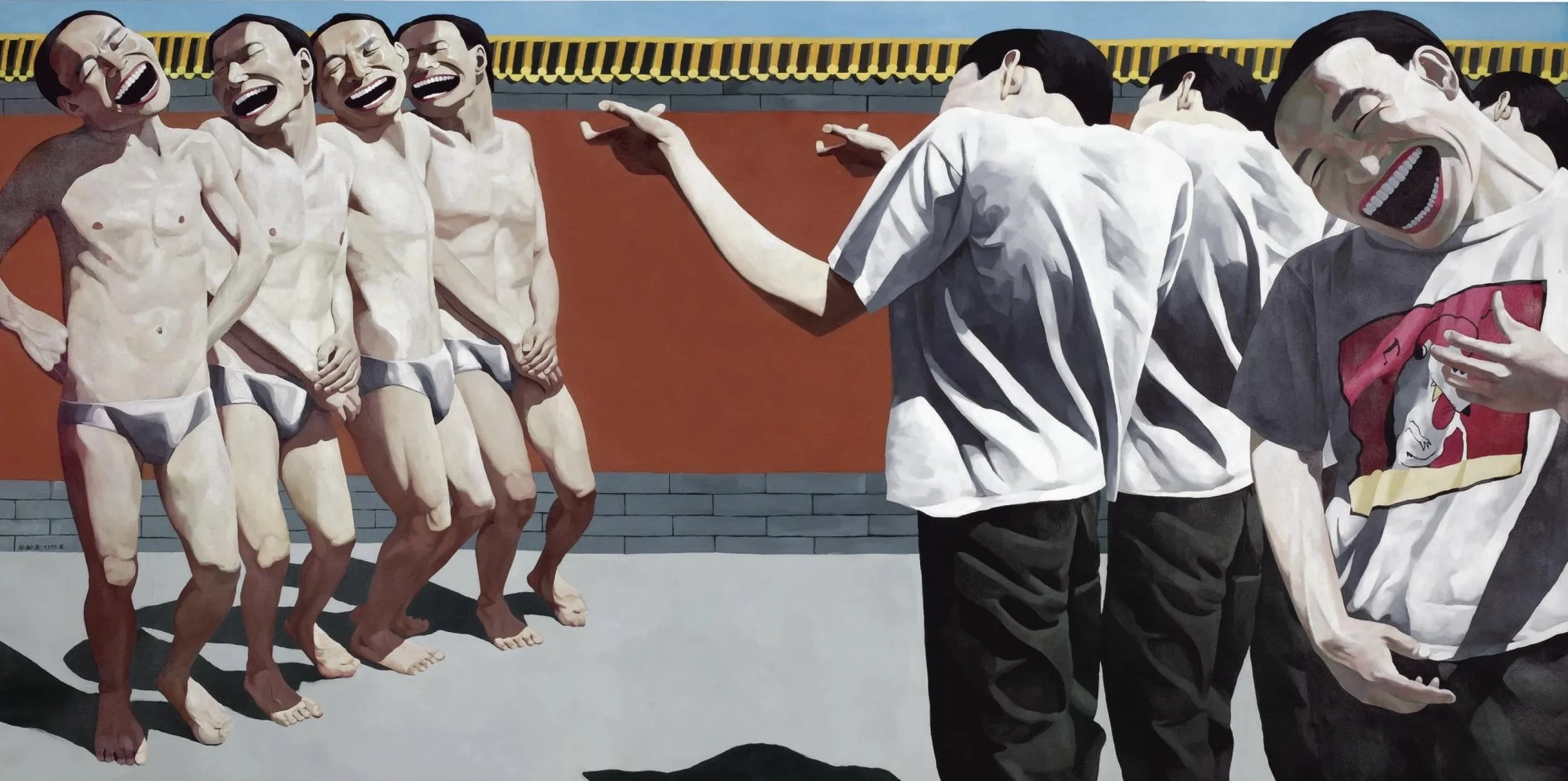
Fig 1. Yue Minjun, Execution, 1995, oil on canvas, 150 cm × 300 cm. Used with permission of the artist.
Introduction
In 1990, Yue Minjun (born 1962) was a little-known art practitioner who had just moved to the Yuanmingyuan artists’ village to join a loose community of bohemian peers. There he became associated with “cynical realism,” a style that grew out of the village, and within a decade he became one of the bestselling artists on the global auction scene. Having received training in socialist realism, Yue paints in a caricatural version of it marked by the recurring motif of the laughing man. This gives his work a distinct recognisability which allowed him to build a brand image that generated massive commercial popularity. His career, not so promising at the start, peaked with the historic 2007 sale of his Execution for $5,977,022 at Sotheby’s London. At the time it was the most expensive work of Chinese contemporary art ever sold at auction. [1]
This essay contextualizes Execution by examining the artistic and socio-historical influences behind its making. The two main categories I will use are Political Pop and Cynical Realism; both concern the form as well as the content of the work. By mobilising the conventions of these genres, Execution portrays the psychological and political mood of the “post-New Era,” defined above all by the Tiananmen Square incident on June 4, 1989. [2] But it is also fundamentally multivalent like much of Yue’s work and cynical realist art in general. Although often perceived as “dissident art” that critiques state violence, it resists such a straightforward reading. This essay understands it as an attempt to capture the historical moment without yielding a stable or singular meaning. I hope to show that this elusiveness – partly the product of conscious artistic intent, partly of circumstance – lends itself most readily to an allegorical approach.
The Post-1989 Movement
Execution, completed in 1995, was a response to the Tiananmen Square protests and massacre in June 1989 (fig. 1) [3]. It depicts the scene of execution taking place outside the iconic red wall of the imperial palace complex at the heart of Beijing (fig. 2). To anyone with even the most rudimentary knowledge of contemporary Chinese history, this reference could not be missed. In its concern, therefore, Execution is highly characteristic of cynical realism, simultaneously a style and a genre whose origins lay in the mood of disillusionment that reigned after ’89.
Following art critic Li Xianting (born 1949), we can conceptualize the background to the Tiananmen Square incident as the “loss of value systems at two historical moments.” First, China’s traditional literati culture was replaced by the May Fourth-New Cultural Movement at the beginning of the twentieth century, with the year 1919 being a symbolic watershed. Second, the 1978 Open Door policy relaxed social, economic, as well as ideological control, so young artists eagerly embraced the influx of western thought, abandoning the “revolutionary realist tradition.” [4] The years 1978–1989, also known as the “New Era,” saw the blossoming of theoretically ambitious experiments in art, from reflections on the lost decades under Mao to enterprises seeking a new foundation for thought and artistic exploration. [5] The liberation in culture subsequently took on greater political momentum, and calls for democratisation and fundamental reform of the political system began to surface, culminating in the June 4 protests, when the Chinese state stood its ground by ruthlessly crushing the student protestors. Cynical Realism, then, was born in response to this abrupt end of the “idealism, heroism, and yearning for metaphysical transcendence’ of the booming 80s. [6]
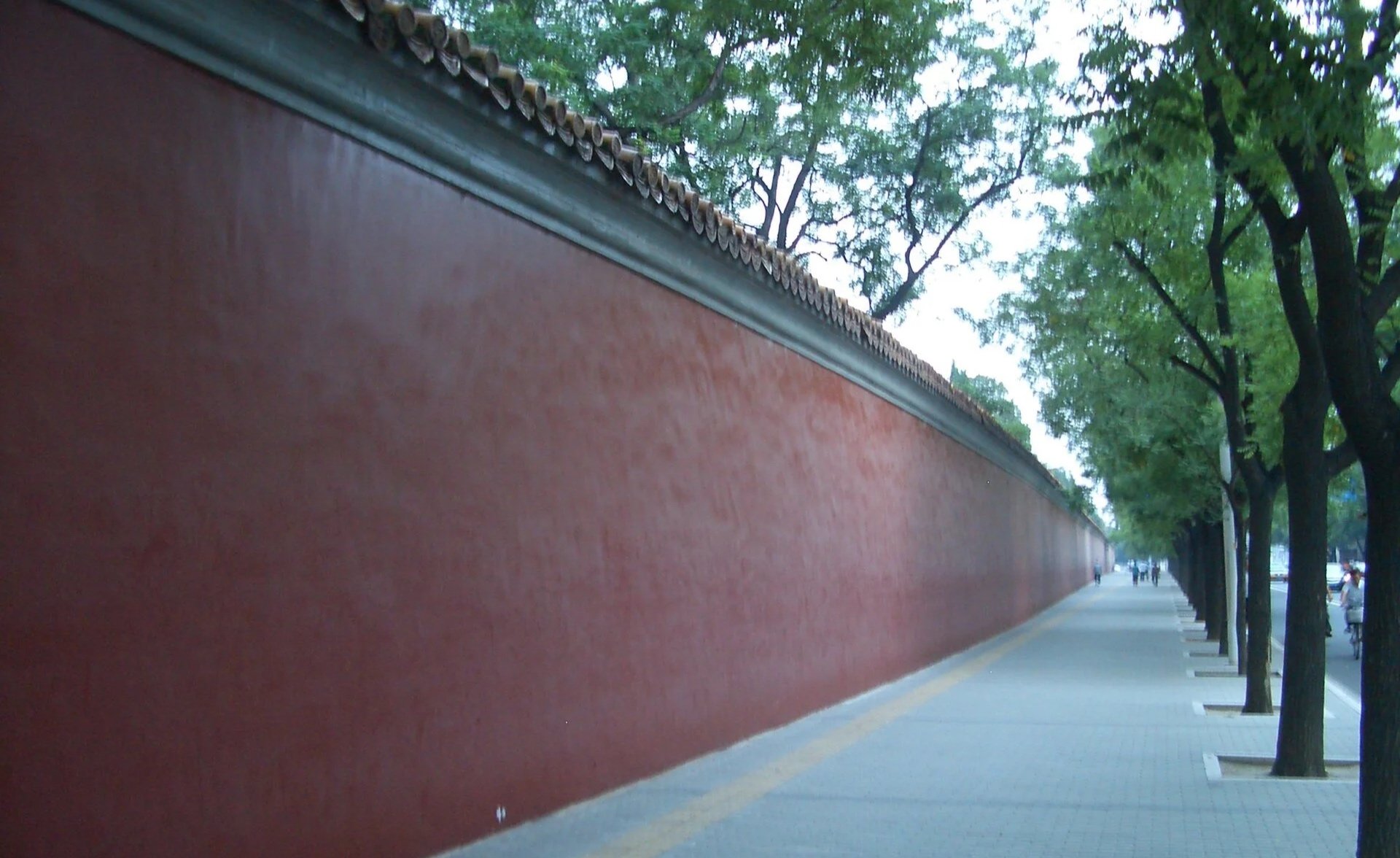
Fig 2. Vmenkov, West Wall of Zhongnanhai, Beijing, August 18, 2008, photograph. Wikimedia Commons. Accessed April 28, 2026. https://commons.wikimedia.org/wiki/File:Zhongnanhai-west-wall-3436.jpg. CC BY-SA 3.0.
The defining themes of the ensuing post-New Era were depoliticisation and materialism. It witnessed “the rise of consumerism, the commercialization of cultural production, and the expansion of the mass media and popular culture,” as well as the waning of the “ponderous, self-reflexive cultural critique” of the previous decade. [7] The events of ‘89 became the traumatic memory of a generation, for intellectuals and students full of enthusiasm for reform now saw unmistakably that there was no way they could alter the ways of the regime. As the “No U-turn” logo of the short-lived China/Avant-Garde exhibition presciently signified, there was no turning back. What further added to the disillusionment of those involved was that in the 90s, rather than going into a political cul-de-sac, China embodied a story of economic and political triumph, of miraculous progress and rise towards national renaissance. Not only did the ideals of reform fail; they were also rendered obsolete and quickly forgotten. For the dissidents, the coming decade did not become another period of underground activity — in a few years cultural control was relaxed again but no new movement sprang up. [8] They were, instead, vanquished and routed thoroughly, and as a result they retreated into the private sphere.
The significance of all this in the field of art was that, unlike “Scar Art,” “Native Soil Art,” and “Root-Seeking Art” of the earlier generation, post-89 artists turned their attention to the mundane, the absurd, and the unserious. Whereas those who emerged in reaction to the sordid dishonesty of propaganda art still harboured a critical message they hoped to get across to the masses, Cynical Realism had no such high-minded agenda. Instead of being informed by a moral mission to show truth as a whole, it takes the form of over-the-top satirical sketches and expresses bewilderment at the changed scene. At the same time, there was also a “conscious shift from representing ‘depth’ to ‘surface.’” [9] By embracing a blanket, featureless setting and refusing symbols pre-invested with meaning, Cynical Realism deviates from the old model of artistic signification: it evokes and gestures towards a meaning but does not convey it. The contemporaneous genre of Political Pop developed along similar lines, with the inspiration coming from Sots Art in the USSR, China’s own burgeoning consumer culture, and Western pop art as typified by Andy Warhol (fig. 3) [10]. More importantly, Political Pop, unlike Cynical Realism, explicitly incorporates elements of satire and play, and does not shy away from addressing the political. It is also highly reliant on existing contexts, although through cross-referencing and juxtaposing heterogeneous symbols, the outcome is often a similarly decontextualized visual hybrid.

Fig 3. Dmitri Vrubel, My God, Help Me to Survive This Deadly Love, 1991, spray paint on concrete, East Side Gallery, Berlin.
Two Genres, One Painting
Execution was painted early in Yue’s career, and stands apart from his other works from the same period. While it is typical in its facetiousness and irony, it departs from the prevailing pattern on two counts. First, it is explicitly political, alluding to an event that to this day remains subject to an official blackout by the Chinese government. No doubt Yue’s early works, and Cynical Realist art more generally, are socially aware, but they are not necessarily political. The importance of this distinction leads to the second point: Execution, conceived in the vein of Cynical Realism, also exhibits features of Political Pop. This is evident in its juxtaposition of symbols displaced from their original contexts and in the way its sarcasm is directed towards a clearly identifiable subject. Yue’s later, more explicit engagement with political satire — Founding Ceremony (1997), The Sun (2000), and Chairman Mao Goes to Anyuan (2005) — in fact dates back to this work.
Art historian Gao Minglu distinguishes two strategies used by Political Pop: they juxtapose “socialist realist iconography and symbols with another, contradictory discursive system”, and restructure the official narrative of socialist realism using the same rhetorical devices drawn from that tradition. [11] For example, Wang Guangyi’s Great Castigation series reappropriates figure types of revolutionary propaganda — workers, peasants, soldiers — and recast them as the spokespeople of iconic consumer brands like Coca-Cola. In Execution the juxtaposition is between graphic tees and the red walls of the Forbidden City, the former representing the consumerist, depoliticized 90s and the latter the somber tragedy of June 4. The effect is a kind of bathos. The volatility and tension of the scene of execution are defused by the fact that neither side seems serious. The firing squad are aiming at the prisoners not with real rifles but imaginary ones. Every person present is lost in the grimacing, infectious Yue Minjun laugh. The fact that the executioners are wearing casual clothes is also significant. In addition to being a reflection of the emergent consumer society it means that there is a lack of visual distribution of authority, of power hierarchy, that comes with the carefully maintained distinction between attires.
Parodying the Old Masters
The contrast becomes clearer when we compare Yue’s painting with the two historical works he parodied. Those two works in question are Francisco Goya’s Third of May 1808 in Madrid (1814) and Édouard Manet’s The Execution of Emperor Maximilian (1868–1869). [12] The layout of Yue’s Execution is based on that of Manet (1832–1883), who had in turn been influenced by the Third of May of Goya (1746–1828). There are a number of parallels worth exploring between these works. As mentioned, in Goya and Manet’s paintings the executioners (French soldiers in Goya’s painting and Mexican republicans in that of Manet) are distinguished from the victims by the oppressing prominence of their uniforms. Difference in dress adds to the sense of confrontation between fully armed soldiers and disarmed prisoners, which is then reinforced by the reciprocal line of gaze along the direction of gunpoint. There is no such gaze in Yue. His victims stood in line, eyes closed, heads half-turned from the threat of violence, a comic distortion of the reality of his subject. Moreover, Manet’s stone wall in the background is replicated in Yue’s painting, and appears as an identifiable tourist attraction; but the spectators who peer over the wall are absent. This detail in Manet’s original is usually interpreted as “a sign of presence and bearing witness.” [13] Creating an internal audience for the execution outside the frame of the painting “exposes its artifice, as representation and pose.” [14] But Yue’s wall seals off the scene entirely, giving us an execution staged without spectators. And where Manet has been more concealing of his feelings, Goya lays out his message directly. He portrays the innocence of the Spanish civilians by attentively rendering their faces and gestures – the man in white shirt kneeling in the centre spreads out his arms in a pose reminiscent of Christ’s crucifixion. In his work, Yue replaces Goya’s helpless gestures and harrowing expressions of horror with raucous, hysterical laughter. As a result he departs from his models on a thematic level as well. Whereas Goya intended to make his work a palimpsest of religious martyrdom, and Manet subtly invites the viewer’s sympathy and engagement, Yue drains the historical gravity of his subject and substitutes an amused resignation. Now we see that both strategies identified above as characteristic of Political Pop are employed in Yue’s presentation of 1989: he restructures an event in recent history and dissolutes its seriousness and sublimity in farce.
The Case for Dissident Art
How then are we to make sense of this bizarre picture? One way is to view it as a straightforward critique: of state violence, of the silent majority who were complicit in pretending not to see, or of the all-engulfing, homogenising postmodern cynicism that is the source of such bathos. Sondra Bacharach, who follows this approach, argues that the contrived superficiality of Yue’s works is meant to cultivate “visual skepticism” on the part of his audience. [15] Because it is so plainly obvious that the painting itself cannot support a convincing, coherent story, we have to seek meaning elsewhere and fill the gaps. Similarly the smile, in its excess, begs the question whether there is any real cause behind it. As in his other paintings, in Execution “the physiognomic expression is completely divorced from the person’s underlying emotional state.” Perhaps it is a call on us to re-examine the grotesque spectacle of the scene and to see it, not just at a literal level, but symbolically “with regard to the socio-political reality of contemporary Chinese life” and as the manifestation of a social pathology. [16]
Yue’s Execution may therefore be categorized as a piece of “creative activism,” which “makes knowledge, experiences, and truths available through and in the art itself and allows audiences to overcome epistemic obstacles that might otherwise prevent them from gaining knowledge.” [17] This returns us to the question of spectatorship raised earlier. In Manet’s painting the perfunctorily sketched internal audience serves to “accentuat[e] the tragic through contrasting indifference,” thereby reminding us of our own status as spectators “passively absorbing the propagandistic images of state violence.” [18] If Yue’s aim is consciousness-raising, where, then, might the trigger be in Execution? An answer lies in his subversion of our expectations of the scene of execution – an ominous thought, since most viewers confronted with this striking image probably would have some knowledge, and thus a mental picture, of the bloodshed on June 4. Tanks rolled into the square, someone fired a first shot, and the crowd evacuated in fright, tripping and stepping over each other. And then we see this burlesque, almost silly image before us, a half-hearted execution that manifests indifference. The emotional response would be at once a sense of shame at our disappointment – at our eagerness to see violence – and a belated shock recognition that history was indeed every bit as bloody as our imagination makes it.
Trauma and Melancholy
Plausible as it may be, this interpretation remains unsubstantiated and leaves our earlier question open: what exactly is “not quite right” with the laugh and those half balding figures? Building on Jason McGrath’s theoretical groundwork, Ho suggests that the iconography constituted from the endless repetition of Yue’s enigmatic figure “evokes the ‘postmodern melancholy’ of the 1990s.” [19] Such melancholy followed from the “perceived foreclosure of modernist utopias,” meaning not only the Maoist utopia but also the utopia of enlightenment and liberal humanism espoused by intellectuals in the 1980s. [20] Seen in this light, the repetition of the enigmatic figure in Execution, impersonating both gunmen and students, anxiously putting up the act and suffering from emotional incontinence, results from a compulsion. They are compelled to keep up the phony performance of carefree merriment precisely because they are constantly haunted by a loss, and Yue’s own compulsion to deconstruct history in representation reveals a desire to repress the actual historical trauma. Cynical realism’s turn towards surface, therefore, masks an obsession with depth, just as its predilection for the low and the bathetic conceals a fixation on the absence of the sublime.
It seems now that Execution is hardly the dissident art we like it to be. Instead, its subject is the whole psycho-intellectual problem of depoliticisation laid out on a canvas, its signification, in the words of Hengzhi Gong, “an allegorical endeavour.” [21] Ho interprets the iconicity of the laughing men motif as an allegory to state power, where “likeness [between individual figures]…is not predicated on actual existence” but “relates to completely imaginary objects or to ideas.” [22] Following this logic, to say that Yue employs “allegorical devices” is to recognize a second level of representation, at which the relation between referent and reference becomes porous, fluid, and open-ended. [23] It makes sense then to say that if the painting does anything it mirrors the mood, the condition, the cognitive dissonance of the 1990s. For this reason its politics are decidedly ambiguous, as it does not purport to repair the disruption of historical coherence but to re-enact it in all its complexity.
Art, Market, and Myth: Another Side of the Allegory
On a different note, however, the story of Yue and his Execution is also a caricature of the interpretation we have so far ascribed to it. It is true that Execution is a work capacious (or vacuous) enough to sustain allegorical readings. Certainly Yue’s foreign buyers understood it as a critique of the 90s money-grabbing, upstart anti-heroism, and a reflection on “the melancholia of broken modernity,” i.e. China’s aborted democratisation. [24] As Larissa Buchholz shows, Yue’s meteoric rise in the international auction scene rested on his art’s “overt national associations” which emerged less from artistic intent than from a series of contingent circumstances. Back when Yue just started out as an artist, the world was dazzled by China's economic successes. Foreign collectors, diplomats, financiers, and journalists flooded into Hong Kong and mainland artistic enclaves, pocketing works of art less for their intrinsic value than as windows onto “the larger political and cultural contradictions marking the country’s dramatic transformations.” [25] In this context, the “brand-like aesthetic” of his signature laughing figures afforded him a competitive advantage over his Chinese peers. [26] The preference of the market also prompted him to develop his style further in this direction. But at this early stage he had no aspirations for his art to become the national allegory it would later be prized as. Crucially, nor did he view his style as “a reflexive rejection of alternative aesthetic frameworks” or political narratives. [27] We should not be content with saying that the mood was in the air. The truth was that Yue was caught in the spiralling logic of capital which rewarded and amplified certain traits in art. Indeed, as Buchholz argues, part of his magical career is a “speculative hype that played out in a globalizing market game.” [28] Without the help of agents, dealers, and a host of other human and institutional actors in the network of art transactions, none of this would have been possible. Now with this hidden half of the picture restored, we may truly say Yue and his record-setting painting are the allegory of their time – the confused, opportunistic, mercenary years of the 1990s and 2000s.
Endnotes
[1] Larissa Buchholz, “The Hype of the Chinese Market Star: Yue Minjun,” in The Global Rules of Art: The Emergence and Divisions of a Cultural World Economy (Princeton, NJ: Princeton University Press, 2022), 234.
[2] Sheldon Hsiao-peng Lu, “Art, Culture, and Cultural Criticism in Post-New China,” New Literary History 28, no. 1 (Winter 1997): 111–33, 112.
[3] Enid Tsui, “Yue Minjun: Behind the Painted Smile,” Financial Times, November 2, 201, https://www.ft.com/content/d15b7a5a-23b0-11e2-a46b-00144feabdc0. Though by way of acknowledgement Yue also tried to qualify the extent of his political commitment.
[4] Li Xianting, “Apathy and Deconstruction in Post-’89 Art: Analyzing the Trends of ‘Cynical Realism’ and ‘Political Pop,’” in Contemporary Chinese Art: Primary Documents, ed. Wu Hung, trans. Peggy Wang, MoMA Primary Documents (New York: Museum of Modern Art; Durham, NC: Distributed by Duke University Press, 2010), 157.
[5] Lu, “Art, Culture, and Cultural Criticism,” 112.
[6] Wu, Contemporary Chinese Art, 154.
[7] Lu, “Art, Culture, and Cultural Criticism in Post-New China,” 112, quoted in Louis H. Ho, “Yue Minjun: Iconographies of Repetition,” Modern Chinese Literature and Culture 25, no. 2 (Fall 2013): 219–48, 220.
[8] Julia F. Andrews and Kuiyi Shen, The Art of Modern China (Berkeley: University of California Press, 2012), 264.
[9] Wu, Contemporary Chinese Art, 154.
[10] Andrews and Shen, Art of Modern China, 260.
[11] Gao Minglu, Total Modernity and the Avant-Garde in Twentieth-Century Chinese Art (Cambridge, MA: MIT Press, 2011), 260–1.
[12] Coincidentally, like Yue (1989–1995), Goya also completed the painting six years after the event (1808–1814).
[13] Kristine Ibsen, “Spectacle and Spectator in Édouard Manet's ‘Execution of Maximilian,’” Oxford Art Journal 29, no. 2 (2006): 213-226, 113.
[14] Ibid., 222.
[15] Sondra Bacharach, “The Laughter behind the Painted Smile,” in Figuring Out Figurative Art: Contemporary Philosophers on Contemporary Paintings, ed. Damien Freeman and Derek Matravers (New York: Routledge, 2015), 174–5.
[16] Ibid, 178.
[17] Sondra Bacharach, “Bearing Witness and Creative Activism,” Journal of Aesthetics and Art Criticism 81, no. 2 (2023): 153–63, 158.
[18] Ibsen, “Spectacle and Spectator,” 225.
[19] Jason McGrath, Postsocialist Modernity: Chinese Cinema, Literature, and Criticism in the Market Age (Stanford, CA: Stanford University Press, 2008), 42, quoted in Ho, “Yue Minjun,” 226.
[20] McGrath, Postsocialist Modernity, 42.
[21] Hengzhi Gong, “As Another Voice: Hidden Political Expression in Contemporary Chinese Allegorical Painting” (PhD diss., Royal College of Art, 2025), 66.
[22] Ho, “Yue Minjun,” 243.
[23] Gong, “As Another Voice,” 59.
[24] Ibid., 69.
[25] Buchholz, “The Hype of the Chinese Market Star: Yue Minjun,” 237.
[26] Ibid., 219.
[27] Ibid., 239.
[28] Ibid., 227.
Hongjin Li
Hongjin (Harry) Li is a rising sophomore studying History at Boston College. He plans to take on a second major and is in the process of figuring out what that would be. He likes parties, travels, and books, and is interested in going to graduate school. He also writes for The Gavel, one of the two main student newspapers at Boston College.